





Summary of this article
As millions of Indians embrace easy access to credit, many are discovering that managing several repayments at different interest rates can become as challenging as taking the loans themselves.
Instead of waiting for financial stress to build up, a growing number of borrowers are consolidating multiple debts into a single loan with one EMI, lower interest costs and a simpler repayment schedule.
For someone struggling to keep track of several expensive debts, consolidation can offer something more valuable than just a lower EMI - a little breathing room and a clearer view of where the money is going.
For years, debt consolidation carried a stigma. It was often associated with borrowers who had lost control of their finances and were looking for a way out of mounting debt. That perception, however, is beginning to change.
As millions of Indians embrace easy access to credit - whether through personal loans, credit cards, consumer durable EMIs or Buy Now, Pay Later (BNPL) products - many are discovering that managing several repayments at different interest rates can become as challenging as taking the loans themselves. Instead of waiting for financial stress to build up, a growing number of borrowers are consolidating multiple debts into a single loan with one EMI, lower interest costs and a simpler repayment schedule.
According to financial experts, the shift reflects how India's borrowing habits are evolving. Household debt continues to rise. Digital lending is booming. And consumers are increasingly aware of their credit scores and long-term financial wellness. In this environment, debt consolidation is gradually emerging not as a rescue measure, but as a practical financial planning tool.
Says Harsh Grover, Co-Founder, LoansJagat.com, “The perception is changing. Debt consolidation isn’t viewed anymore as a last resort for borrowers under financial trouble. More and more, we're seeing it being used as a financial planning tool.”
The numbers tell us the same story. As of March 2026, India's household debt rose to 45.5 per cent of GDP. Within household borrowing, non- housing retail loans (comprising personal loans, credit cards, and loans against consumer durables) stood at 58.4 per cent of total loans. Credit today is far more diversified than before.
Borrowing today is far more diversified than it used to be.
“We see this shift daily. Customers arrive not because they have missed payments, but because they want one EMI date instead of five. Rising interest rates on unsecured credit, growing awareness of credit scores, and easier digital comparison tools are all pushing consolidation from a crisis response toward a mainstream financial habit,” he adds.
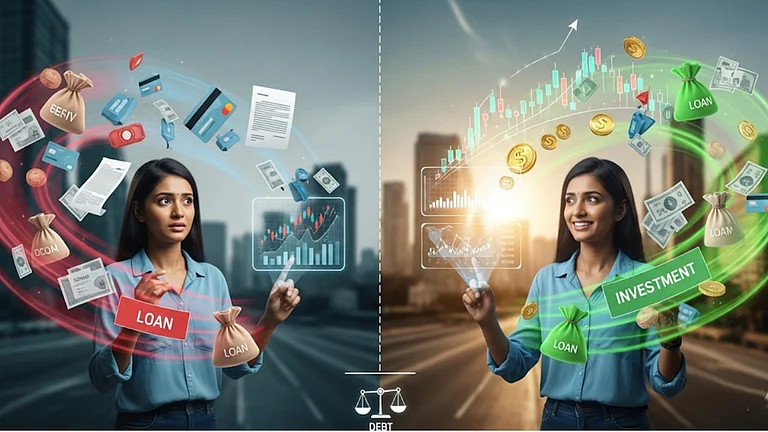
The Problem Is Not Always The Size Of The Debt
For many borrowers, the real problem is not one massive loan. It is the accumulation of several relatively small ones.
Consider someone earning Rs 70,000 a month. There may be a personal loan running in the background, two credit card balances, an EMI for a smartphone or appliance and perhaps a short-term loan taken for a family event. Individually, each borrowing may have seemed manageable. Together, however, they can create a confusing monthly financial picture.
There are different due dates, different interest rates and different lenders to keep track of. One missed payment can also trigger additional charges and potentially hurt the borrower's credit profile.
“Combination borrowing is now the default, not the exception,” says Grover.
TransUnion CIBIL’s “Beyond the Swipe” report found that among diversified credit users, 55 per cent also carry consumer durable loans, while 53 per cent hold high-ticket personal loans and 36 per cent have small-ticket personal loans in addition to their cards. Among high-exposure borrowers, 74 per cent are juggling high-ticket personal loans alongside card debt.
The profile is, therefore, changing. “The typical profile walking through our doors is not someone with one large debt. It is someone with four or five smaller ones,” says Grover.
BNPL has added another layer, particularly among younger borrowers who may see it primarily as a convenient payment option rather than another form of borrowing. The convenience can make credit feel less visible - until several repayment obligations begin arriving at the same time.
Millennials Lead, But Younger Borrowers Are Catching Up
Millennials currently make up the largest chunk of debt consolidation enquiries. This is not surprising. They are often in their peak earning years but are simultaneously dealing with multiple financial commitments - home loans, vehicle loans, children's expenses and lifestyle-related borrowing.
“But younger borrowers are entering the credit market earlier. Nearly seven out of ten Indians under 30 have at least one loan, while fintech loan book volumes had crossed Rs 2 trillion by June 2025, up more than 25 per cent year-on-year,” says Grover.
Demand is also moving beyond the big metros. Tier-2 and Tier-3 cities account for 64 per cent of new personal loan applications. Cities such as Coimbatore, Indore and Bhubaneswar have recorded nearly 40 per cent year-on-year growth in loan demand.
Salaried employees in technology, healthcare and retail remain an important customer segment, while small business owners managing both personal and working-capital borrowing are emerging as another growing group. Most active borrowers fall in the Rs 40,000 to Rs 1 lakh monthly income bracket.
One EMI Can Mean More Than Convenience
The obvious attraction of consolidation is simplicity: instead of remembering several repayment dates, borrowers have one EMI to manage.
But the bigger benefit can be discipline.
Multiple repayment dates increase the chances of forgetting a payment, particularly when a borrower is managing several accounts. “Since repayment history plays an important role in credit scoring, consistent payments can make a meaningful difference over time,” says Grover.
He cites one example where a borrower's CIBIL score initially fell by seven points following a hard enquiry for the new loan, but improved by 25 points within three months of timely repayments and by 36 points within six months.
Consolidation can also improve monthly cash flow.
According to Grover, customers who have consolidated multiple loans and credit card dues have typically reduced their interest burden by as much as 10 per cent and monthly EMI outflow by up to 50 per cent, depending on the rates they were paying earlier.
That surplus amount can go towards your emergency fund or savings or other financial goals if you are not spending it elsewhere.
Technology Is Making The Process Smoother
Credit card debt consolidation is also easier now because of fintech platforms. Earlier, borrowers with loans from multiple lenders would have to visit each lender, compare interest rates and tenures and negotiate balances. With websites doing this legwork, they can compare offerings from multiple banks and NBFCs at once.
Moreover, the process can be completed digitally, from KYC and approval to disbursal, with funds usually credited within 24 hours of sign-off.
Technology is also disrupting how lenders evaluate borrowers. Lenders can evaluate a borrower’s position holistically through credit bureau data, repayment history and debt-to-income ratio instead of just salary slips and income documents.
More than 10.9 crore personal loans amounting to Rs 1.06 lakh crore were sanctioned during FY2024-25. By March 2026, the RBI expects fintechs to account for roughly 56.8 per cent of the small-ticket personal loan segment.
From Rescue Tool To Financial Planning Tool
As credit becomes easier to access, the need to manage it intelligently will become increasingly important. Debt consolidation could become part of that process.



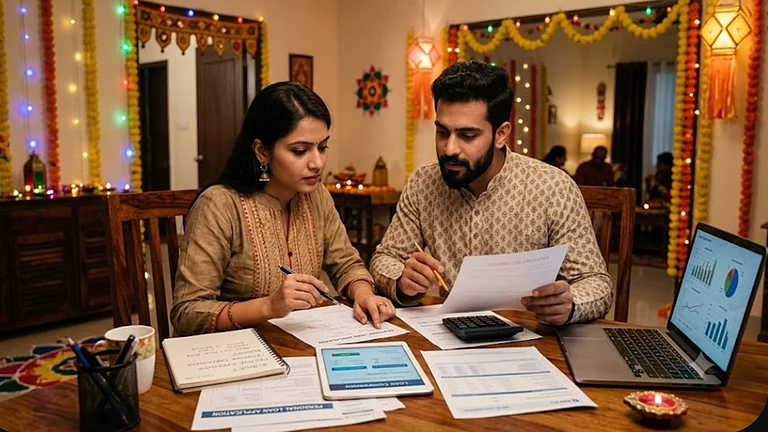
Grover expects the market to evolve around three major trends: embedded consolidation, where lending platforms identify fragmented borrowing and suggest consolidation proactively; deeper penetration in smaller cities; and greater regulatory scrutiny of BNPL and small-ticket credit.
The idea is not that every borrower with multiple loans should immediately consolidate. A new loan only makes sense if its overall cost, including interest, fees and tenure, genuinely improves the borrower's financial position.
But for someone struggling to keep track of several expensive debts, consolidation can offer something more valuable than just a lower EMI - a little breathing room and a clearer view of where the money is going.
That may explain why debt consolidation is slowly shedding its old image. It is no longer necessarily a sign that someone has lost control of their finances. For an increasingly credit-dependent generation, it may simply be another way of putting those finances back in order.





