





Summary of this article
As technology reshapes employment and the gig economy expands, the Centre is considering reforms to allow unorganised workers access to EPFO and ESIC. Officials say multiple measures are underway to improve pension outreach, including free doorstep services, while policymakers explore how to adapt contribution-based social security to new work models and income thresholds
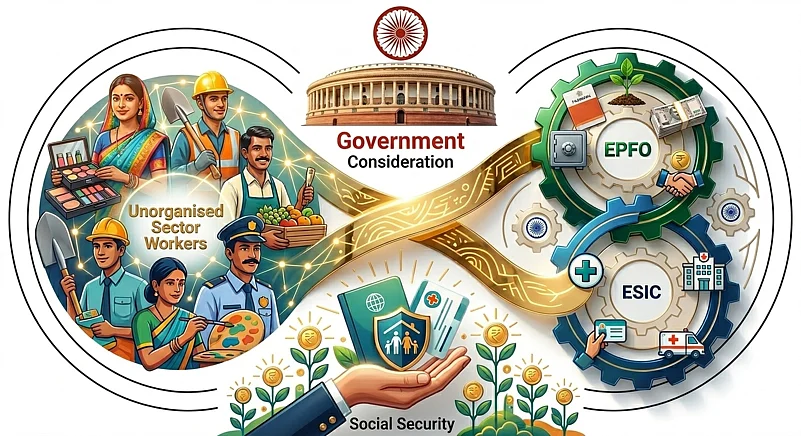
The government is considering bringing in the unorganised sector workers under the Employees’ Provident Fund Organisation (EPFO) and the Employees’ State Insurance Corporation (ESIC) schemes coverage.
Recently, Shobha Karandlaje, Minister of State for Labour and Employment, during the question hour in the Lok Sabha replied on a supplementary question, saying, ““At present, it is being deliberated in the labour department that that the unorganised workers should get pension in the coming days as the prime minister desires that all those who work should get pension and they should come under the ambit of the EPFO and ESIC,” PTI reported.
Notably, the advancing technology has changed the traditional employment culture. The gig economy is growing. The new labour codes also ensure that gig workers are covered for social security schemes.




The Pension Fund Regulatory and Development Authority (PFRDA) has also introduced the NPS e-Shramik model for platform and gig workers to ensure a pension for them.
According to the minister, several initiatives are being taken by the government to improve the pension schemes and their outreach. The free doorstep service is one such service, launched to offer ease of service to subscribers. The government is also contemplating extending pension benefits to those working in the online industry.

Note that EPFO offers three schemes under its kitty. These are employee provident fund (EPF), employee pension fund (EPS), and employee deposit-linked insurance (EDLI), to ensure the subscribers are covered for insurance, and save regularly for retirement to get a lump sum fund and pension during the golden years. However, the scheme is only for the organised sector workers and is mandatory for up to Rs 15,000 salary, including dearness allowance.
EPFO operates under the administrative control of the Ministry of Labour & Employment, Government of India.

Similarly, ESIC, which manages the ESI scheme, also comes under the control of the Labour Ministry. The scheme applies to certain establishments as defined under the ESI Act, 1948. It includes workers in factories, shops, hotels, newspaper establishments, educational institutions, etc., having 10 or more employees. The coverage, however, is restricted to employees earning not more than Rs 21,000 (for persons with disabilities, the limit is Rs 25,000).
Both the coverage (EPFO and ESIC) is based on contributions by the employee and the employer both.





