



Summary of this article
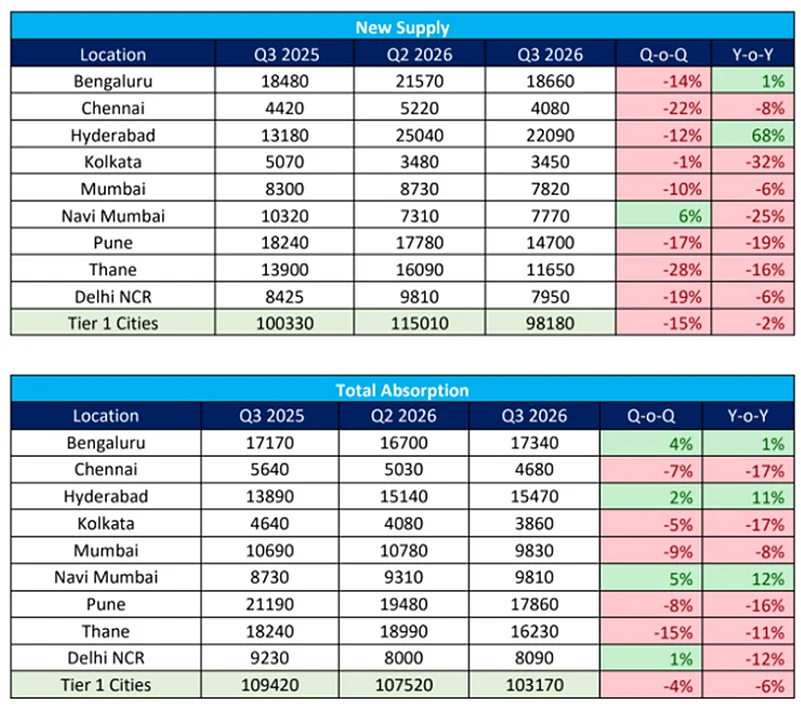
Housing sales stood at 1,03,170 units in Q3 2026, down 6 per cent from a year earlier and 4 per cent from the previous quarter, according to PropEquity.
At the same time, new launches fell 15 per cent quarter-on-quarter to 98,165 units from 1,15,010 units in Q2.
The decline in launches indicates that developers are becoming more selective about adding fresh inventory in several markets.
Housing sales across India’s top nine cities moderated in the July-September quarter, but developers also brought fewer new projects to the market, helping keep the demand-supply balance relatively steady.
Housing sales stood at 1,03,170 units in Q3 2026, down 6 per cent from a year earlier and 4 per cent from the previous quarter, according to PropEquity. At the same time, new launches fell 15 per cent quarter-on-quarter to 98,165 units from 1,15,010 units in Q2.
The sharper decline in new supply meant that sales, or absorption, remained higher than fresh launches by nearly 5,000 units during the quarter. This suggests that developers have been more cautious about adding inventory even as demand has softened.
The overall picture, however, varied significantly across cities. Navi Mumbai and Hyderabad recorded the strongest year-on-year growth in sales at 12 per cent and 11 per cent, respectively. Bengaluru was largely stable, with sales rising 1 per cent.
At the other end, Pune recorded a 16 per cent decline in housing sales, followed by Chennai at 17 per cent, Thane at 11 per cent and Mumbai at 8 per cent.

The reduction in new supply was more broad-based. Thane saw the sharpest quarter-on-quarter decline in launches at 28 per cent, followed by Chennai at 22 per cent and Delhi-NCR at 19 per cent. Pune also recorded a decline in new supply.
“Q3 2026 reflects a significant drop of 15 per cent Q-o-Q in new supply while the absorption numbers remain stable with a minor drop of only 4 per cent despite large drop in supply,” said Samir Jasuja, Founder and CEO, PropEquity.
According to Jasuja, the leading cities have been operating around the one-lakh-unit quarterly mark for both new supply and absorption for nearly two years. He said this points to a more settled market, with annual supply and absorption of around four lakh units and roughly 750 million sq ft of new annual supply.

Developers Turn Cautious
The decline in launches indicates that developers are becoming more selective about adding fresh inventory in several markets. Across the nine cities, new launches were down 2 per cent year-on-year and 15 per cent from the previous quarter.
The trend was particularly visible in Thane, Chennai, Delhi-NCR and Pune, where developers reduced new supply sequentially.
There were, however, some notable exceptions. Hyderabad saw new launches jump 68 per cent year-on-year even as sales grew 11 per cent. This points to a much wider gap between fresh supply and absorption in the city compared with most other markets.


Navi Mumbai, meanwhile, saw new launches fall 25 per cent year-on-year, while Kolkata recorded a 32 per cemt decline. PropEquity said the broader reduction in launches reflects a cautious approach by developers, aimed in part at keeping existing inventory levels under control.
For homebuyers, the numbers suggest that the market is no longer seeing the same pace of expansion in either sales or new project launches. With developers holding back supply in several major cities, the coming quarters will show whether this restraint helps the market maintain a healthier balance between inventory and demand.





