





Summary of this article
The Bombay High Court slams the Railway Tribunal for passing an order based on contradictory reports.
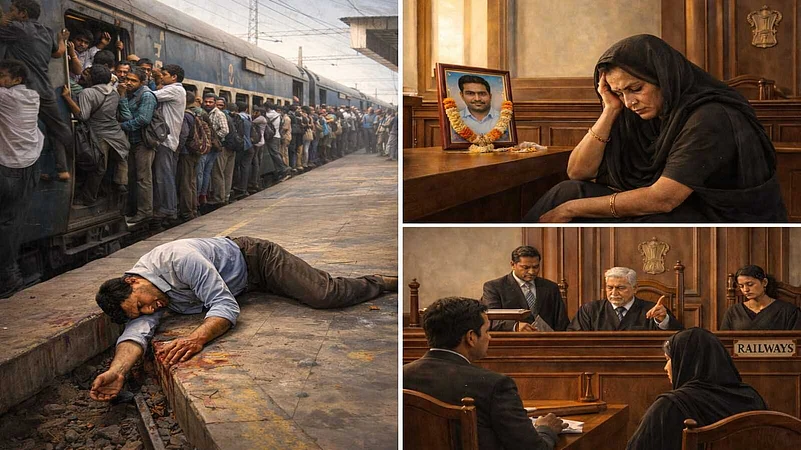
A railway employee fell from a crowded train in Virar in 2010, declared dead upon arrival to hospital. The family claimed compensation.
The Railway Tribunal rejected, saying the accident was not an untoward incident.
The Bombay High Court rebuked the Railways for bureaucratic rigidity in settling a claim for compensation in a railway employee’s death in 2010. The family of the deceased employee has been running from pillar to post to get the compensation from the institution, Western Railway, where the deceased served until his death in a train accident. Justice Jitendra Jain expressed that it is distressing that the family of the deceased had to run from here and there to receive their rightful dues, and overturned the Tribunal Order.
Case Background
The deceased was an employee of the commercial department in Railways, posted in Elphinstone Road in Mumbai. On September 11, 2010, after finishing his shift, he was travelling from Elphinstone Road to Virar in the early morning at 3:00 am. As the train approached Virar Railway Station, he fell from the moving train due to the heavy rush and sustained fatal injuries. He was taken to a primary health centre but was declared dead upon arrival.
His family claimed compensation, but their application was rejected. The Railway Claims Tribunal rejected the claim in March 2015, on the basis that the death did not qualify as an “untoward incident”. The Tribunal passed its order, ignoring the three different and contradictory reports.




Arguments
The counsel of the claimant (petitioner) argued that the deceased, as a railway employee, possessed a valid free pass and contended that his death resulted from an accidental fall due to overcrowding. The counsel highlighted that the scenario fits into the definition of an “untoward incident”, and thus, compensation should be paid.
The respondent (Union of India) argued that the passenger was not a bona fide passenger because no free pass or valid ticket was recovered from the site of the incident. They argued that the incident is not an “untoward” one. The respondent’s counsel suggested that the deceased might have been trespassing or crossing the track when he was struck by the train.

Court Observation
The Court observed that the Tribunal made a ‘grave error’. It noted that the Tribunal considered three documents: A station master memo, an inquest panchnama, and a Divisional Railway Manager (DRM) report. However, these three reports were ‘diametrically opposite and contradictory’.
It noted that “in the station master memo, it is stated that the deceased is found lying on the platform down through track between Nallasopara and Virar. The Tribunal further records that in the inquest panchnama, it is stated that the death of the deceased appears due to dashing against a mail train, and since the deceased was staying near Virar, the chances of trespassing are high. The Tribunal further records that in the DRM report, it is stated that the deceased was knocked down while crossing the track.”
The conflicting reports led the Court to dismiss the trespassing theory, noting that the deceased was a railway employee. On the argument of a missing pass, the Court ruled that, being a railway employee, the deceased was entitled to a free pass, and mere absence of a physical document at the scene could not take away his ‘bona fide passenger’ status.

Court Judgment
The High Court then set aside the Tribunal’s order and allowed the appeal. The Court rules that the accidental fall from a moving train comes under the "untoward incident" under Section 123 (c) (2) of the Railways Act, 1989. The Court directed the respondent to pay the claimants a compensation of Rs 4 lakh and an interest at the rate of 6 per cent from the date of the accident, with a cap of Rs 8 lakh, within eight weeks.





