





Summary of this article
India has another NEET problem. The bigger challenge is the growing number of young people who are Not in Employment, Education or Training (NEET) despite spending years and lakhs of rupees on higher education.
Today the cost of college education has gone up significantly and takes more years to earn it back, if the job comes at all. The return on investment (ROI) from lower ranked expensive private colleges is not impressive irrespective of what their brochures claim.
Families carefully analyse each stock and mutual fund scheme before investing. But when it comes to one of their biggest investments (i.e. education), they still follow a framework that has barely changed since the 1990s.
Every year, millions of Indian parents make the biggest investment of their lives - not in a house or a business, but in their child's education. They save for years, liquidate investments, mortgage property, or take education loans, believing that a good degree will secure a stable, well-paying career. That formula worked for many families in the past. But in 2026, the rules are shifting. As artificial intelligence (AI) transforms workplaces and organisations reassess the purpose of entry-level hiring, many of our assumptions about education are being disrupted.
India has a NEET problem - just not the one you read about every time there’s a medical entrance exam scandal. The bigger challenge is the growing number of young people who are Not in Employment, Education or Training (NEET) despite spending years and lakhs of rupees on higher education. Many others have found work, but in jobs that neither match their qualifications nor provide the income needed to justify the cost of their degrees. For parents, this raises an uncomfortable question: Is the traditional education roadmap still the safest investment for a child's future?
“A family I know spent around Rs 15 lakh on their son's engineering course at a well-known college in their state. The high-paying job never came after this undergraduate degree. So, they did what most families do: they immediately doubled the bet, taking an educational loan of Rs 25 lakh for an MBA from a private college nowhere near the top 25 in India. The admission brochure had shown 100 per cent placements with leading MNCs. He finished two years ago, sat for a few campus interviews that did not convert, and slowly lost hope of finding a well-paying job. The loan EMI has not stopped,” says Sougata Basu, Founder of CashRich, a wealth management platform.
If you think a bit, you will find similar situations in your extended family or neighbourhood. In 2021, the job market was relatively booming, and such examples were less common. Something fundamentally changed around November 2022.

The Degree That Stopped Paying For Itself
Once you go beyond the highest salary packages to a few top students from premier institutes in India, the story quickly changes.
“20 years ago, an average fresher's job in IT started around Rs 2.5 to 3.5 lakh annual salary. Even today the average fresher starts in a similar range, often just 20 per cent higher. The exceptions are a small minority from top campuses or with specialised skills. After 20 years of inflation, the value of money has changed dramatically. A rupee today buys less than one-third of what it did back then. In other words, a salary of Rs 3.5 lakh in 2006 would need to be close to Rs 12 lakh today to offer the same purchasing power,” says Basu.
Two decades ago, the fee for an engineering degree was in the range of Rs 2 to 4 lakh, and it paid for itself within two years. Today, the cost of college education has gone up significantly and takes more years to earn it back, if the job comes at all. The return on investment (ROI) from lower-ranked expensive private colleges is not impressive, irrespective of what their brochures claim.
The fresher's salary hasn’t moved much for 20 years. Only the college fees kept moving.
For a large proportion of Indian families, investing in a child's education is the topmost financial goal. This is the largest cheque they will ever write, and that one investment allocation shapes the family’s future for the next 20-30 years. Families carefully analyse each stock and mutual fund scheme before investing. But when it comes to one of their biggest investments (i.e. education), they still follow a framework that has barely changed since the 1990s.
The Jobless Number Is Hiding The Truth
The official statistics on Indian unemployment hide the strain. Unemployment of 5.5 per cent in May 2026 doesn’t accurately reflect the problems of the NEET population. Youth joblessness runs in double digits. Industry surveys have repeatedly found that roughly half of graduates lack the skills the corporate world needs.
India needs nearly 8 million new non-farm jobs every year until 2030, as per the government's own Economic Survey. We struggled to hit that number even before AI. Now, many entry-level white-collar roles may not survive. The challenge is no longer creating jobs. It is creating AI-resilient jobs.
Even Top Institutions Cannot Place Everyone
If you ask students why the jobs and internships are tough to get, you will hear one word: recession. But currently, there is no recession in India or the US. India’s real GDP grew around 7.7 per cent last year, the fastest for any major economy. When the best growth story in the world cannot place its best-qualified graduates, the problem is deeper and further investigation is required. As we move further from the top-ranked institutions in India, the picture becomes worse.
“If the diagnosis is wrong, every rupee spent on the wrong degrees and courses is money at risk. Worse, the years lost cannot be recovered. That time could have gone into building skills the market actually pays for. A large education loan for the wrong course does not just burden the child. It quietly eats into the family's other financial goals, including the parents' retirement savings,” says Basu.
What Is Really Behind It: Artificial Intelligence
The engine of that change is AI. The shift started with the launch of ChatGPT in November 2022. India's exposure is significant as it is impacting a strong job-creating sector.
The Information Technology (IT) and BPO industry lets millions of families believe that a college degree would lift their household financially. But now job uncertainty has increased in this sector. Gross layoffs across India's broader technology sector crossed 100,000 in 2025.
The market has delivered its verdict too: share prices of TCS, Infosys and Wipro have roughly halved from their record highs. Around Rs 19 lakh crore has been erased across the top 10 IT names on fears that AI shrinks the people-heavy outsourcing model. A Rs 2,000-a-month AI subscription now does work that once needed several different skill sets and years of study. Set that against a fresher's salary, and you will see the huge cost gap employers are staring at today.
“AI has been coding very well and has progressed dramatically in the quality of the output in the last three years. In parallel, other jobs such as marketing, accounting, financial analysis, legal documentation, etc., are also getting automated by AI at a fast pace. So, the risk of job losses as well as reduction in entry-level hiring is spreading much beyond the technology sector,” observes Basu.
5 Steps To Future-Proof Your Child’s Career
Just memorising the definition of ‘Artificial Intelligence’ is not enough.
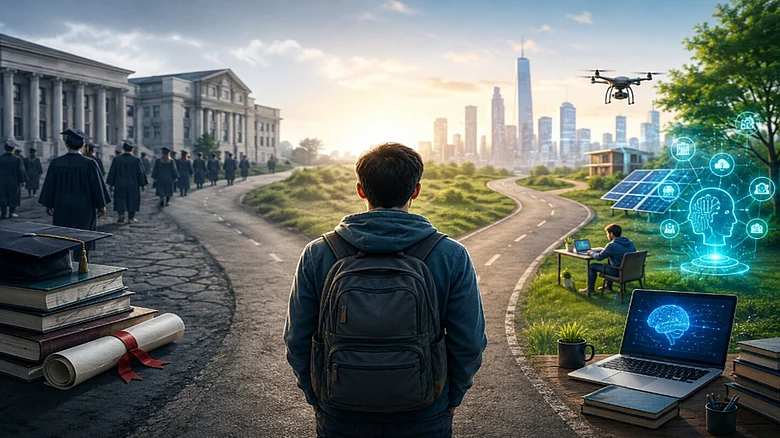
First, build the child for adaptability, not for a job that exists today. Communication, critical thinking, creativity and judgment hold their value, no matter which AI model is in fashion. A young person who can orchestrate multiple AI agents will likely out-earn one with a longer list of degrees and certificates.
Second, “make AI a daily tool at home, not a distant threat. Learning to instruct it well (prompt engineering) is becoming what learning to search the web was twenty years ago. Instead of using AI to finish homework, it can be used to create interactive practice tests. Whether the child becomes a doctor, a CA or a lawyer, he will use AI at work,” says Basu.
Third, encourage practical work via real-world projects, internships and small businesses. If the college is not top tier, taking a purposeful gap year building projects, working as a trainee or starting a small venture has more value than drifting on a temporary escape route into a Master's degree or an MBA using a fresh education loan.
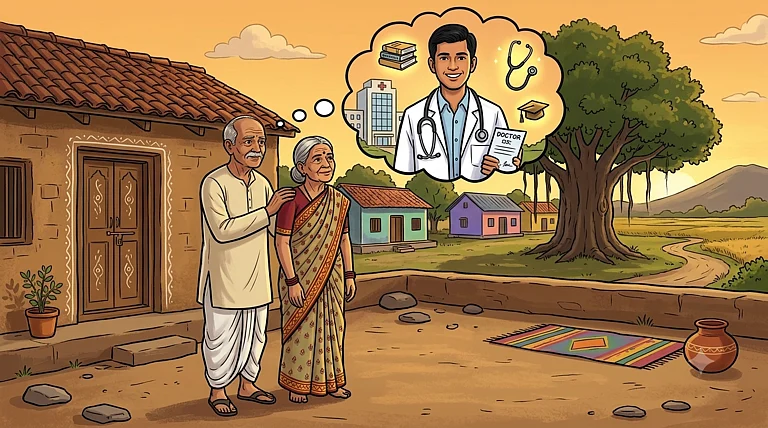


Fourth, allocate the family's capital deliberately. The family above put Rs 40 lakh into two degrees (plus additional fees to coaching institutes) and got no job. A better strategy may have been to invest Rs 10 lakh in a high-quality education that provided practical skills and keep the remaining Rs 30 lakh as seed capital for the son’s own venture.
In 2026, a MacBook and a Claude subscription may now be worth more to your child's career than a degree certificate from a lower-ranked college. Parents who have used these AI tools extensively tend to agree instantly. Parents whose only exposure is occasional free chatbot use for correcting emails have not yet seen the agentic world (AI that completes tasks, not just answers questions). That gap in the parents' own experience quietly becomes a gap in the child's preparation.
Fifth, “if you plan to send your kids abroad for education, invest in courses that will provide relevant skills for the future, and not just a prestigious brand name. Also, start saving in the currency you will eventually spend. If your future expenses will be in US dollars, gradually build your investments in USD. The Indian rupee has historically weakened against most major currencies over the long term. Global education requires global financial planning,” suggests Basu.
The real question is not: Will the degree help to get a job?
It is: Will the skills from that education keep the child employable for the next 30 years?
The Question Worth Sitting With
India will almost certainly be a much larger economy in 2037. How the wealth gap between the rich and the poor will change during this period will be an important metric to track. The families who position themselves on the right side of AI are likely to do better financially.
Imagine your child's future as an investment portfolio. Are you placing one large, concentrated bet on a single degree, or one 'safe' profession, or dependent on a single economy, or are you building genuine optionality and diversification?





