





Summary of this article
In the current scenario, potential investors do not evaluate their prospects in the market based on one parameter – value appreciation.
They are taking a holistic view, which includes weighing whether it is more comfortable to enjoy steady rental income or wait for a bigger payout in the future.
What’s taking shape in NCR is a market that’s being driven by two distinct, yet complementary engines: assets that generate steady, predictable income, and corridors that are steadily building long-term value.
For decades, investments in real estate in Delhi-National Capital Region (Delhi-NCR) have been made in a tried-and-tested manner: one enters early enough, enjoys the appreciation in value, and exits at the appropriate time. That paradigm seems to be changing now.
In the current scenario, potential investors do not evaluate their prospects in the market based on one parameter – value appreciation. Instead, they are taking a holistic view, which includes weighing whether it is more comfortable to enjoy steady rental income, or wait for a bigger payout in the future. The process is becoming more rational, driven by hard facts, geographical factors, and investment time horizons.
In previous cycles, the speculative nature of capital was what primarily determined the market’s performance, with growth seeming inevitable. The current cycle is marked by a much more realistic attitude. Questions like “What can this produce for me per annum?” and “What is its value in five years from now?” are asked more and more frequently.
According to recent statistics from the market, there is a consistent rise in housing prices within the emerging corridors, especially the areas around Dwarka Expressway, Greater Noida (specifically the western side and the expressway belt), and the sectors along the expressway.
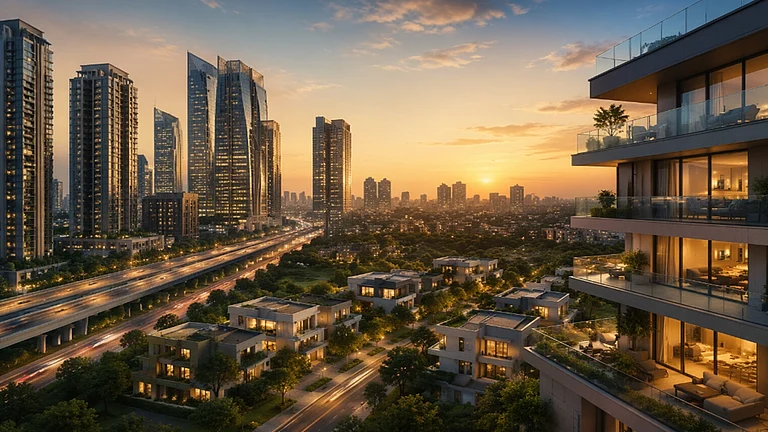
According to a Cushman and Wakefield report, high-end residential submarkets in Delhi-NCR recorded annual capital appreciation in the range of 3-4 per cent in Q1 2026, while Noida and Gurugram witnessed sharper year-on-year (y-o-y) price growth of nearly 10 per cent and 7 per cent, respectively. What’s underpinning this growth is not sentiment alone, but tangible progress on the ground: improved connectivity, metro expansions, and the steady build-out of social infrastructure.
Another report by Cushman and Wakefield states that main street rentals in Galleria Market (Gurugram) recorded a 14 per cent growth on a yearly basis, while Khan Market in Delhi witnessed an annual rental increase of 8 per cent in Q4 2025. Kamla Nagar in Delhi and Sector 18 in Noida posted rental growth of 8-11 per cent on a yearly basis. Rentals in South Extension and Rajouri Garden have also grown by 3-6 per cent compared to last year.
In terms of Grade A offices, average rentals in Delhi-NCR crossed Rs 100 per sq ft per month for the first time, touching Rs 105. This threshold has long been seen as a benchmark for mature office markets, and breaching it indicates that Grade A assets in key micro-markets are tightening.
Sandeep Chhillar, founder and chairman, Landmark Group, says: “The investors’ outlook has changed over the past couple of years. There’s a clear divide in approach - some are leaning into emerging corridors like Dwarka Expressway with a long-term view, backing the infrastructure story and the appreciation it can unlock over time. At the same time, there’s equally strong interest in income-led assets, particularly well-located Grade A office buildings or mixed-use developments where rentals are far more predictable. Interestingly, many investors aren’t treating this as an either-or decision anymore. They’re consciously balancing both - steady yield on one side, capital growth on the other. To developers, that shift says a lot about how the market has evolved; it’s far more measured, far more intentional.”
Pankaj Jain, founder and chairman and managing director (CMD), SPJ Group, says that in commercial real estate, the conversation has always been anchored around yield, but today it’s becoming more structured. Investors are not just chasing returns; they are evaluating the quality of tenants, lease structures, and long-term sustainability of income.
“In high-performing retail and office micro-markets across Gurugram, we are seeing consistent rental yields, which when backed by strong occupier demand, become a very compelling proposition. What has changed is the mindset; investors today value stability and predictability just as much as upside, and that’s where well-leased commercial assets continue to stand out,” he adds.
Seen together, residential and commercial aren’t really competing choices anymore; they are playing different roles within the same portfolio. In residential, the approach is clearly split: emerging corridors are being viewed through the lens of capital appreciation, while established locations continue to offer steady rental income. Commercial, on the other hand, remains more firmly anchored in yield, with leased office spaces and high-street retail increasingly seen as annuity-style assets that bring consistency to returns.
Ashwani Kumar, Pyramid Infratech, says, “The residential market in Delhi-NCR is currently being shaped by two parallel forces. On one hand, there are end-users and investors focusing on ready or near-ready homes in established sectors, where rental income provides a sense of financial comfort and continuity. On the other hand, there’s a growing segment of buyers, particularly in emerging corridors, who are less concerned about immediate returns and more aligned with long-term capital appreciation. What’s driving this confidence is visible infrastructure progress and improved livability. The decision today is less about timing the market and more about aligning the investment with one’s financial goals and holding capacity.”
Mohit Batra, regional director, Realistic Realtors, says, “What we are witnessing in NCR is a clear segmentation of investor behaviour based on risk appetite and investment horizon. Previously, capital appreciation was often assumed across the board, but today, investors are far more realistic in their expectations. They understand that appreciation is location-specific and time-dependent, while rental yield is closely linked to occupancy and economic activity. In many ways, this shift is healthy for the market, as it reduces speculative excess and brings in a more disciplined approach to real estate investment.”
Thus, what’s taking shape in Delhi-NCR is a market that’s being driven by two distinct, yet complementary engines: assets that generate steady, predictable income, and corridors that are steadily building long-term value. If this approach continues to deepen, Delhi-NCR may well stand out not just for the pace of activity it sees, but for the quality and intent behind the investments it attracts.





