







Summary of this article
EPFO's CBT meeting on November 19 may raise EPS pension.
It may be increased from a minimum of monthly Rs 1,000 to Rs 3,000.
A retirees need 10 years of service to qualify for the pension scheme.
The Central Board of Trustees (CBT) of the Employees’ Provident Fund Organisation (EPFO) will have its 240th meeting on November 19, 2026. It was scheduled to be held in Gir, Gujarat, but the venue has now been shifted to Delhi. The meeting is expected to hold discussions on raising the minimum monthly pension under the Employees’ Pension Scheme (EPS) from Rs 1,000 to Rs 3,000.
Incidentally, the Ministry of Labour and Employment has reached a decision on the increase in EPS pension; however, neither the Labour Ministry nor the Finance Ministry has confirmed this decision, according to a report by Money Control.
Although the employee unions have been demanding a hike to Rs 7,500 for a long time, and the Parliamentary Standing Committee on Labour, Textiles and Skill Development, in its 15th Report on ‘Demands for Grants (2026-27)’ also recommended an increase in the minimum pension under EPS, no announcement has been made on the it by the government yet. Beneficiaries need to wait until the day of the meeting to know whether the government is actually increasing the pension or not.




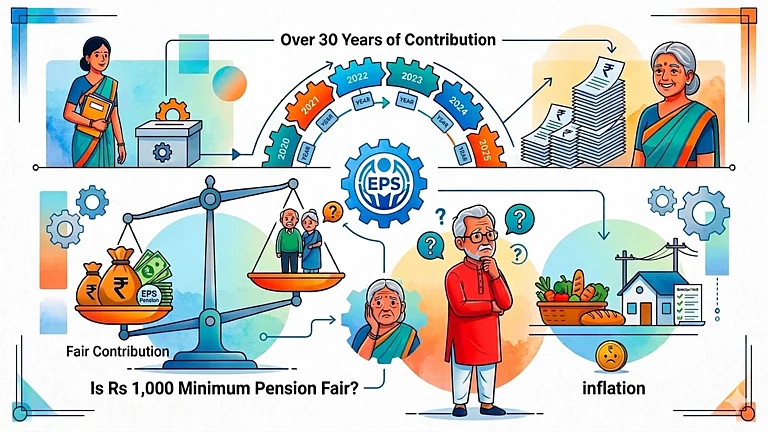
The minimum pension was last increased in September 2014 to Rs 1,000. But since then, several representations have been made by pensioners to increase the monthly pension further, considering the rising cost of living, healthcare expenses, and inflation.
Under the old EPS rules, EPS was a mandatory deduction for all employees irrespective of their salary. But, from September 1, 2014, it was made mandatory only for those earning up to Rs 15,000 per month. Now, the rules have been further changed. Under EPS 2026, which has replaced EPS 1995, EPS deduction is mandatory for all employees earning up to Rs 25,000 per month.
For central government employees, the National Pension System (NPS) is mandatory. Several states have also made NPS mandatory for their state government employees, whereas some states offer their employees both NPS and the Old Pension Scheme (OPS). However, for private sector employees, EPFO schemes, including the EPF, EPS, and the Employees’ Deposit Linked Insurance (EDLI), have long been the only options offered by employers for long-term financial security.
To be eligible for EPS after retirement, which is 58 years of age, one has to complete at least 10 years of service in one or more EPFO-covered organisations. At the time of superannuation, PF is paid in a lump sum, and EPS is determined based on the employee’s last few months’ average salary and number of contribution years, using this information in a formula.

The entire 12 per cent of an employee’s contribution goes toward EPF every month, whereas only 8.33 per cent of the employer’s contribution from the matching 12 per cent goes towards EPS, and the remaining 3.67 per cent to EPF.
The scheme secures the employee’s family as well. It has the provisions of widow pension, children’s pension, orphan pension, permanent total disability pension, and family pension.





