







Summary of this article
The Madhya Pradesh High Court held that a Hindu marriage cannot be formed or dissolved through a notarised agreement.
The court dismissed a family pension claim because the man failed to prove a valid legal marriage with the deceased woman.
It ruled that private documents cannot override the legal requirements of the Hindu Marriage Act.
The Madhya Pradesh High Court dismissed a claim for family pension filed by a man who asserted to be the husband of a deceased government employee. The case highlights a general misunderstanding that the notarised marriage agreements or notarised divorce papers carry the weight of law.
While the appellant man sought terminal benefits after the death of a tribal department worker, the court’s decision underscores that Hindu marriage is a sacramental union, not a mere contract that can be formed or dissolved at a notary’s desk.
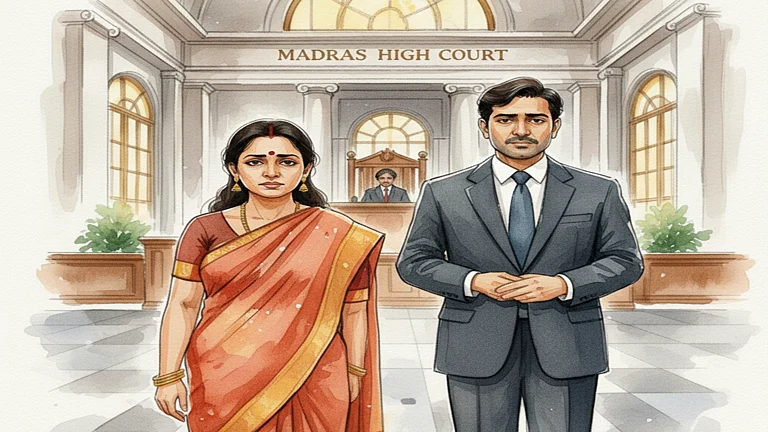
The dispute started after the death of the tribal department worker (Suman Devi) in August 2022. She was a permanent employee in the Department of Tribal and Welfare, where she served as a Chowkidar. The appellant, Ram Kripal Singh, filed a writ petition seeking terminal benefits, family pension, and other financial dues, claiming that he was the deceased woman’s husband. However, the State government contended this by presenting a legal heir certificate and service records according to which another man, Kok Singh Kushwaha, was her husband and father of her children.




Arguments
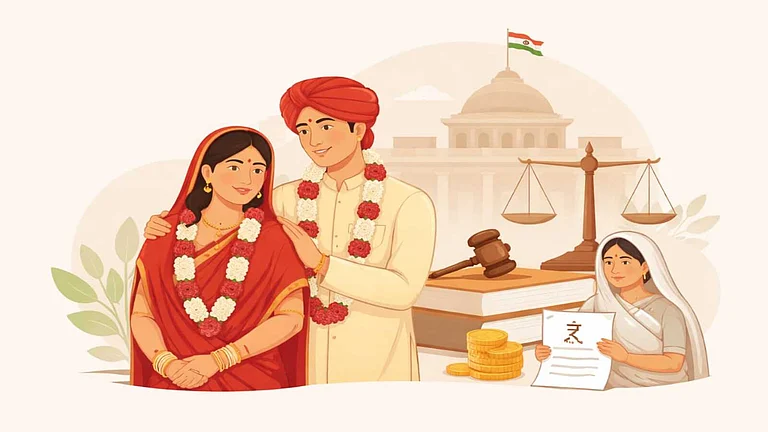
The counsel for the appellant argued that Suman Devi divorced her first husband (Kok Singh) in 1998 through a notarised agreement and later married Ram Kripal Singh in a court marriage in September 2000. To support his argument, appellant produced a death certificate, an arms license, and an affidavit for a change of nominee, where his name was mentioned as the husband of the deceased woman. He further provided the notarised marriage agreement dated July 14, 1999.
On the other side, the State’s counsel presented the original service book, in which Kok Singh was listed as the husband. The counsel produced a 2004 letter from the deceased herself, in which she explicitly clarified that Ram Kripal (Appellant) was not her husband and that she had no relation with him.
Court Observation
Justice G S Ahuwalia and Justice Anuradha Shukla examined the evidence and the Hindu Marriage Act. They observed that no decree of divorce under Section 13 of the Act was ever issued to sever her first marriage with Kok Singh. The court also noted that Singh could not prove any social custom under which notarised agreements are considered valid marriages.
The court stated, “In order to prove custom, the aspirant must prove that the custom was not only recognised by the society but is also still in existence for the last several years, or it was ever recognised by the courts. Marriage is not a contract under Hindu law, and therefore, it cannot be performed by executing a notarised agreement of marriage.”
“Under these circumstances, it is held that appellant has failed to prove that he was ever married to the late Smt. Suman Bai,” noted the court.

Court Judgment
The High Court held that the deceased woman remained the legally wedded wife of Kok Singh until her death. As the appellant failed to prove a valid marriage, the court ruled that the appellant didn’t have any legal status as the deceased’s husband and thus was not entitled to any benefit, whether terminal or pension.
The court held that private agreements cannot override the statutory requirements of the Hindu Marriage Act and dismissed the appeal.





