







Summary of this article
The Madhya Pradesh High Court has upheld the pension rights of a divorced daughter.
The court called the exclusion of a divorced daughter from the MP Civil Services (Pension) Rules, 1976, violative of Article 14 of the Constitution.
It quashed the 2021 rejection order and directed the authorities to reconsider the family pension request.
The Madhya Pradesh Civil Services (Pension) Rules, 1976, cover daughters, whether married or unmarried, under the definition of family, but not divorced daughters. In such a matter where a family pension was sought for a divorced daughter, the Director General, Home Guards and Civil Defence, Jabalpur, rejected the request, citing that the divorced daughter is not included in the family’s definition, making her ineligible for receiving family pension.
In this matter, the Madhya Pradesh High Court reinforced the constitutional rights of divorced daughters, while addressing the critical gap in the MP pension rules of 1976. The rules had omitted divorced daughters from the explicit definition of ‘family’, whereas unmarried, married, widowed, adopted, and step daughters were included.



Case Background
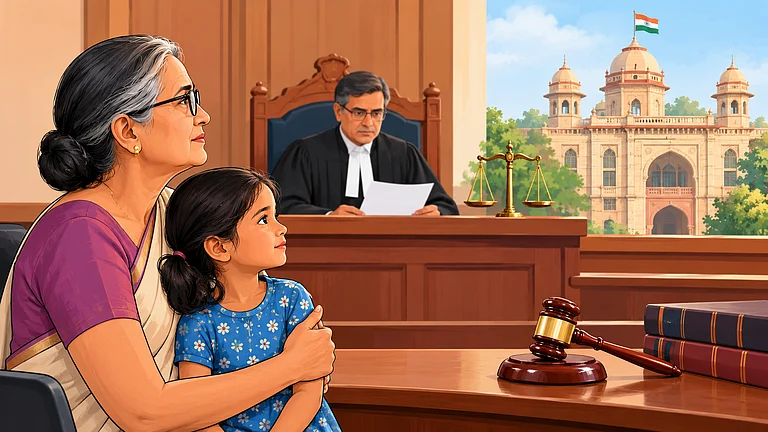
The petitioner, a divorced daughter (Jyoti Shrivastava), reached the court by filing a writ petition. Her father (late Shanker Lal Shrivastava) served as a District Commandant in the Home Guards, who retired in 2001 and had nominated her for the family pension. Following her mother’s death in 2017, the petitioner claimed the family pension, but it was denied to her. On December 16, 2021, the Director General, Home Guards and Civil Defence, Jabalpur, rejected the claim on the grounds that she didn’t qualify as a dependent under Rule 48 of the 1976 rules.
Arguments
Petitioner’s counsel argued that her exclusion was arbitrary and against the precedents. The counsel submitted that the Ministry of Personnel, P.G. & Pensions, Department of Pension and Pensioners' Welfare issued an office memorandum dated September 11, 2013, in which it clarified that divorced daughters are entitled to the family pension of the deceased employee, subject to fulfilling the earning and dependency conditions.
Conversely, the counsel representing the State maintained that the petitioner’s claim was correctly rejected. The counsel contended that, according to Rule 45 of the 1976 Rules, the petitioner was not recognised as a dependent, and thus, the impugned order has no legal error.

Court Observation
Justice Vishal Dhagat noted the definition of family under Rule 44(5), which is about death-cum-retirement gratuity, and observed a prominent inconsistency. The court noted, “Rule 44(5) of the Rules of 1976 includes unmarried daughters, including step daughters and adopted daughters, widow daughters, including step daughters and adopted daughters, unmarried sisters and widow sisters, including step sisters and married daughters.”
As divorced daughters are not included in the rule, the court found this classification irrational, violating the fundamental right to equality under Article 14.
It stated, “If divorced daughters are not included within the definition of family, then fundamental rights guaranteed under Article 14 of the Constitution of India shall be violated as there is no difference between unmarried daughter, married daughter, or divorcee daughter.”

Court Judgment
The court then quashed the rejection order dated December 16, 2021, ruling it a violation of the constitutional rights. It directed the respondents to reconsider the petitioner’s application, and if she is indeed dependent on the deceased government servant and has no income of her own, a pension must be granted to her. The court gave 90 days to the competent authority to receive the petitioner’s representation and evidence and pass a fresh order.





