







Summary of this article
The Tripura High Court has denied family pension to a woman who lived with her father for over 40 years and was financially dependent on him, ruling she was ineligible because she was still legally married when he died in 2018. The court held that, as per the rules, a daughter must be divorced or have initiated divorce proceedings before the pensioner’s death
A woman who was financially dependent on her father for over 40-years has been denied family pension after her father’s death. In a recent case, the Tripura High Court denied family pension to the daughter due to the timing of her divorce. Family pension is a welfare benefit that is offered to the family of the deceased employee. However, in the case of a daughter, the eligibility for family pension changes with the status of her marriage and divorce, before or after the employee’s demise.
In this case, the petitioner is the daughter of a former labourer (father) with the Agartala Municipal Corporation. The father retired in 2004 and died on December 2, 2018. His wife pre-deceased him. During his lifetime, he got his daughter married, but her husband deserted her a few days after the marriage. Since then (for over 40 years), she has been staying with her father and has depended on him financially. Finally, on October 4, 2021, she received a divorce decree by mutual compromise. It was then that she applied for the family pension.





However, her family pension claim was denied by the municipal corporation because at the time of her father’s death in 2018, she was married and thus did not fulfil the criteria for a divorced daughter at the time of her father’s death.
The counsel of the petitioner argued that there is no explicit restriction in the Revised Pension Rules, 2017 that the daughter’s divorce has to be finalised or even initiated during the pensioner’s lifetime. Therefore, the corporation cannot deny the pension by creating two different classes of family pensioners.
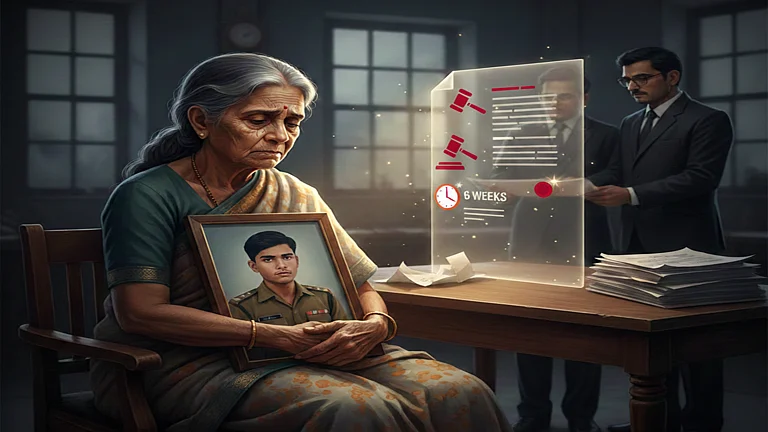
In response, the counsel for the corporation argued that pension eligibility must accrue immediately on the date of death, or if divorce is not finalised, it should at least have been initiated when the original pensioner was alive. As the petitioner had the status of ‘married daughter’ when her father passed away in 2018, she is not entitled to a family pension. The counsel also contended that the petitioner is seeking a pension from the date of her father’s death, whereas she obtained a divorce decree in 2021.
Court Observation And Judgment
Justice S. Datta Purkayastha noted that under Rule 8 of the state’s pension rule, a divorced daughter of the original pensioner is entitled to receive family pension on his or his spouse’s death, as the case may be. It noted that the condition precedent for entitlement to family pension is that that daughter should be divorced at the time of the original pensioner’s death.

In the present case, the court observed that the daughter was legally married, separated from her husband, but not divorced, and thus cannot be covered for the family pension benefit. It also referred to the Office Memorandum dated July 19, 2017, which clarified that family pension shall be extended to divorced daughters where divorce proceedings were started during the lifetime of the original pensioners, even if the decree was issued later.
The court also emphasised that under Article 226, the court cannot rewrite the rule and enlarge its scope, and thus, it is not discrimination because only specified categories of divorced daughters are entitled to family pension, not all. The court dismissed the petition.





