







Summary of this article
DoRD and PFRDA signed an MoU to expand pension outreach in rural areas.
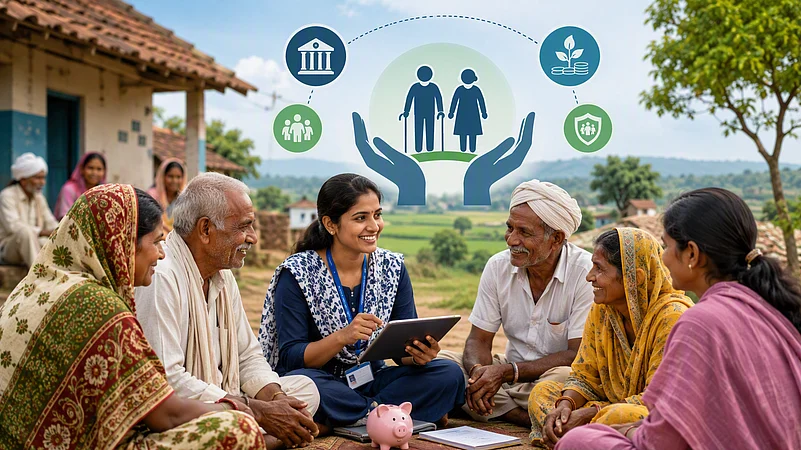
Pension Sakhis will guide rural citizens on retirement plans.
Digital dashboards like LoKoS will track real-time progress.
India’s rural financial inclusion is set to undergo a significant change as the government is set to take pension products and long-term retirement plans to underserved areas. In a major development, the Department of Rural Development (DoRD) and the Pension Fund Regulatory and Development Authority (PFRDA) signed a Memorandum of Understanding (MoU) on September 15, 2026, to establish a mechanism of outreach in rural regions through ‘Pension Sakhis’. The MoU was signed between Amit Shukla, joint secretary, DoRD, and Sumeet Kaur Kapoor, executive director, PFRDA.
This partnership aims to enhance pension awareness, financial literacy, enrolment, and post-enrolment support in underserved areas. The purpose is to provide rural people who depend on agriculture, informal labour, or small businesses, and earn irregular income to save for the long term instead of simply using basic banking.





The on-ground implementation of strengthening outreach efforts, the already established network of Deendayal Antyodaya Yojana–National Rural Livelihoods Mission (DAY-NRLM), will be utilised, with a specific focus on leveraging women-led self-help groups (SHGs) and banking correspondent (BC) sakhis.
These local facilitators will act as ‘Pension Sakhis’ to take PFRDA-monitored pension schemes to the underserved areas. They are aimed at bridging the guidance gap for households who don’t have access to formal financial advice. The programme will engage SHG members, rural women, Lakhpati Didis, and other community participants to explain the retirement plans to rural people, guide them for enrolment, and assist them with their pension service queries.
According to the press release by the Ministry of Rural Development, this initiative aims to address the broader demographic changes in the country, where increasing life expectancy and the growth in the elderly population are making long-term financial planning increasingly critical.
Rohit Kansal, secretary, DoRD said that households in the SHGs have different risk profiles, livelihood patterns, and saving habits. These households need to be informed about social security as it can provide them with the confidence and financial stability instead of being just a safety net against financial hardships.
Mamta Shankar, whole-time member, PFRDA, said that expanding the reach of formal mechanism like the National Pension System (NPS) is vital for rural citizens who currently don’t have social security coverage.

As the implementation takes effect, participating institutions will integrate their digital dashboards along with Web and mobile tracking tools, including the department’s proprietary LoKoS system, to oversee the outreach.
According to the release, these technological solutions will provide real-time information about enrolments and support the field teams in identifying the underserved geographies and try to fill the gaps. These specialised digital platforms will also focus on local service delivery and monitoring efforts to strengthen outreach efforts.





