






Summary of this article
CGFSEL covers eligible education loans up to Rs 7.5 lakh.
Loans can be available without collateral or third-party guarantee.
Borrowers remain responsible for repaying loans and applicable interest.
Education loans can help students unlock a multitude of opportunities. But getting such loans often requires collateral in the form of a security, which many students often find difficult to arrange. However, under the Credit Guarantee Fund Scheme for Education Loans (CGFSEL), education loans of up to Rs 7.50 lakh can be covered without collateral security and third-party guarantee.
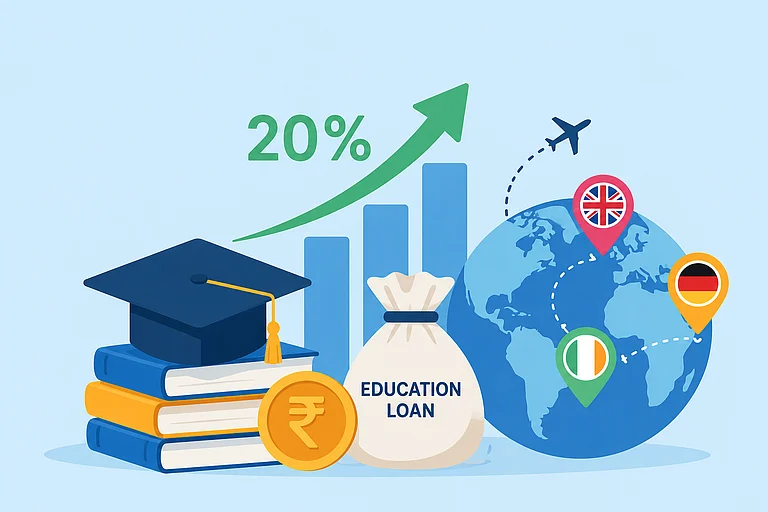
According to the National Credit Guarantee Trustee Company (NCGTC), CGFSEL provides guarantee coverage to eligible lending institutions for education loans to eligible borrowers. The scheme does not mean that the government directly lends money to students. Banks and other eligible lending institutions provide the loan, while the credit guarantee covers part of the lender’s risk.
How Does The Guarantee Work
The maximum guarantee cover under CGFSEL is 75 per cent of the amount in default, according to the NCGTC’s official FAQ. The guarantee is meant to protect the lender against a specified portion of the loss if the borrower defaults.
However, this does not mean that the student is free from the responsibility of repaying the loan. The borrower remains responsible for the outstanding loan and the applicable interest.
Who Can Take These Loans
According to the NCGTC, an eligible borrower is an Indian national who meets the eligibility criteria under the Indian Banks’ Association’s (IBA's) Model Educational Loan Scheme for higher education in India and abroad.
The Department of Financial Services (DFS), in its 2025-26 Annual Report, says the Model Educational Loan Scheme covers Indian nationals who secure admission to a higher education course in a recognised institution in India or abroad through an entrance test or merit-based selection process.
Parents or guardians generally act as co-borrowers or joint borrowers. For a married student, the spouse or parents or parents-in-law may act as the joint borrower, according to the NCGTC FAQ.
CGFSEL covers loans provided by eligible member lending institutions. The NCGTC lists public sector banks, private sector banks and foreign banks that are members of IBA, as eligible lending institutions.
What Courses And Institutions Are Covered
CGFSEL does not have a separate standalone list of approved courses and institutions. Eligibility is linked to the criteria under the IBA’s Model Educational Loan Scheme.
The scheme covers higher education courses in recognised institutions in India or abroad, where admission is secured through an entrance test or merit-based selection process. As such, students should check whether their course and institution meets the applicable recognition requirements and whether the lending bank considers the loan eligible for coverage under CGFSEL.
Is There An Income Or Academic Requirement
The NCGTC's CGFSEL FAQ does not specify a family income ceiling or a minimum percentage of marks as a separate CGFSEL eligibility condition.
The Rs 4.50 lakh annual family income limit linked to the Central Sector Interest Subsidy Scheme (CSIS) is a condition for a separate interest subsidy benefit and should not be treated as a general CGFSEL income limit.
The DFS report refers to admission through an entrance test or merit-based selection process. The lender may also assess the student’s academic record and other details at the time of processing the loan.
What Are The Interest Rates
CGFSEL does not set one common interest rate for all education loans. The Reserve Bank of India (RBI) states that interest rates on education loans sanctioned by scheduled commercial banks (SCBs) have been deregulated.
The interest rate will, therefore, depend on the lender and the terms of the individual loan. Students should check the rate of interest, benchmark, spread, repayment period and other charges before accepting the loan.
Which Documents Are Required
CGFSEL does not prescribe one common document checklist for all borrowers. The requirements can vary between banks.
A lender may ask for identity and address proof, academic records, admission documents, course and institution details, fee information, and documents relating to the parent or guardian acting as co-borrower. Students should check the specific document requirements of their bank before applying.
What Borrowers Should Know
CGFSEL is a credit guarantee arrangement and not a loan waiver. A student who takes an education loan remains responsible for repaying the loan and applicable interest.
Students and parents should confirm with the lender whether their proposed loan qualifies for CGFSEL coverage before assuming that collateral will not be required.





