






Summary of this article
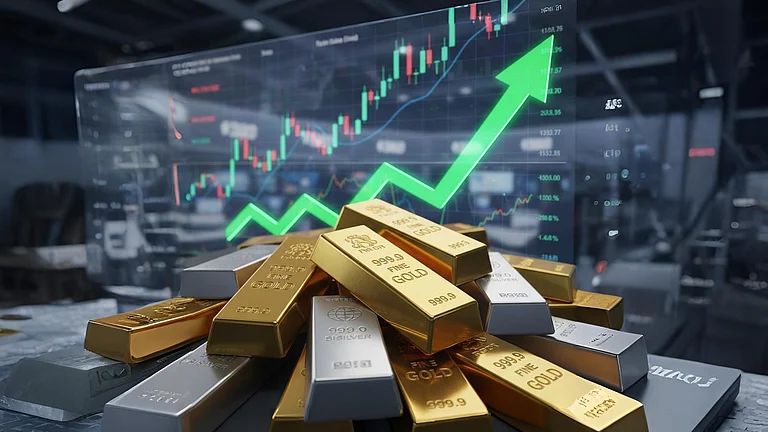
MCX silver prices breached an all-time high of Rs 2,14,000 per kilogram on December 22, 2025, driven by global spot prices crossing 69 dollars.
The rally is fueled by cooling US inflation, multiple Federal Reserve interest rate cuts, and a structural global supply deficit lasting five consecutive years.
Surging demand from green energy, electric vehicles, and AI infrastructure has further tightened inventories, propelling silver prices up 130 per cent year-to-date.
MCX Silver Price: Silver prices have witnessed a significant surge in 2025. On December 22, silver prices climbed to fresh all-time highs. The gains were driven by a combination of factors along with an underlying industrial scarcity.
A surge in spot silver prices past the $69 per troy ounce in international markets was followed by silver prices on the Multi Commodity Exchange (MCX) breaching the Rs 2,14,000 per kilogram mark, indicating a surge of more than 130 per cent year-to-date. Notably, Silver Futures with March 5, 2026, expiry have surged nearly 3 per cent to a record high of Rs 2,14,583 per kilogram.
Why Are Silver Prices Skyrocketing
Explosive industrial demand and favourable macroeconomic shifts are among the key factors which are driving silver prices past the Rs 2.14 lakh per kilogram mark on the MCX. Here’s a look at how some of these factors have contributed to the surge:
Global Macroeconomic and Monetary Factors
The most recent trigger for silver’s rally is the release of US economic data, which strengthens expectations of future interest-rate cuts by the US Federal Reserve. In mid-December 2025, the U.S. Bureau of Labor Statistics (BLS) reported that headline inflation cooled to 2.7 per cent and core inflation cooled to 2.6 per cent. On December 22, commodity markets reacted to signs that US inflationary pressures are easing faster than expected.
Notably, easing inflationary pressures decreases the need for a restrictive monetary policy. Any potential rate cut or the heightened chance of a rate cut increases demand for non-yielding assets like silver, which perform well when borrowing costs fall and bond yields weaken. So far, the Federal Reserve has announced three rate cuts.
Safe Haven Appeal
Apart from the cooling inflation, the safe-haven appeal of the precious metal is also likely to have jumped due to geopolitical tensions, including conflicts in Eastern Europe and new trade blockades involving Venezuela. Such events often push investors toward buying safe-haven assets like silver. Closer home, the weakness of the Indian Rupee (INR) against the US Dollar is also likely to have contributed to the rally as India imports more than 90 per cent of its silver. A weakening rupee makes domestic MCX prices rise quickly than global spot prices.
Structural Supply-Demand Gap
One of the most significant factors driving the price rise is a chronic global shortage of the precious metal. Notably, 2025 is the fifth consecutive year in which silver’s supply has remained less than its demand, according to market intelligence firm SFA Oxford. The price surge is backed by the fact that silver has an inelastic supply, according to SFA Oxford’s report, nearly 70–75 per cent of silver is mined with other metals such as copper, zinc, and lead.
Thus, mine production cannot scale up to meet rising demand. According to the Interim Silver Market Review by the Silver Institute, global silver inventories, including the LBMA (London Bullion Market Association and Shanghai, have hit decade-level lows, which increases the demand-supply deficit, increasing prices. Anindya Banerjee, Head of Currency and Commodity Research, Kotak Securities told Outlook Money that the current surge hints at a structural breakout, not a speculative bubble.
“This is a structural breakout, not a speculative bubble — though short-term froth and sharp pullbacks are part of the journey. Silver has been running multi-year supply deficits, exchange inventories are shrinking, and physical premiums are rising globally. This is not a paper-only phenomenon — availability of deliverable metal is tightening,” Banerjee said.
Rising Industrial and Green Energy Demand
Silver is an essential industrial commodity due to its inherent properties of conduction. According to the Silver Institute, nearly 60 per cent of the global demand for the metal is driven by high-growth technology sectors. Sectors such as solar energy use the precious metal for manufacturing photovoltaics (solar panels) and making other industry goods such as silver paste.
Kaveri More, Commodity Analyst at Choice Broking told Outlook Money that silver's surge past the $67 mark is backed by a five year supply deficit compounded by copper and zinc mine supply disruptions.
"Silver's surge past $67 per ounce marks a structural breakout fueled by persistent supply deficits now in their fifth year explosive industrial demand from solar panels, EVs, and electronics, plus safe-haven flows amid geopolitical tensions and Fed easing, compounded by copper and zinc mine supply disruptions that tighten byproduct silver output (as silver is often mined alongside these base metals), rather than a pure speculative bubble that typically lacks these robust fundamentals," More said.
Additionally, the transition to electric vehicles has increased the demand for silver as they require more of the precious metal than internal combustion engine-powered cars. AI infrastructure and data centres have also heightened the demand for silver-coated connectors and semiconductors. In 2025, the strategic stockpiling of the precious metal has also boosted demand following the U.S. government’s official classification of silver as a "critical mineral”.
Hareesh V, Head of Commodity Research, Geojit Investments told Outlook Money that while silver has broken through resistance zones, several short-term risks continue to persist.
"Technically, silver has broken through decades-old resistance zones, signaling a long-term bullish trend. However, short-term risks persist," Hareesh said.
Hareesh also mentioned that investors should factor in the volatility of silver so that they are not forced into a panic sale. He urged investors to size positions conservatively, use volatility metrics, and plan exits in advance.
"Silver’s volatility is legendary—its price often moves two to three times more than gold during periods of stress or momentum. This means a 5–10 per cent daily swing is not unusual, and without proper position sizing, such moves can trigger emotional decisions and panic selling. Size positions conservatively, use volatility metrics, and plan exits in advance. This discipline transforms silver’s sharp moves from a source of panic into an opportunity for long-term gains," Hareesh said.


Hareesh added that investors can consider partial rebalancing amid the rally and bring their overall holding in silver in-line with the ideally advised size of 10 per cent of the portfolio depending on the investor's overall financial goal.
"If your original asset allocation strategy exceeding 10 per cent indicates concentration risk. In such cases, rebalancing back to target helps maintain discipline and prevents emotional decisions during sharp price corrections. However, silver’s current rally is supported by structural factors that suggest the bullish trend may have longevity, making a case for holding rather than immediate trimming. Meanwhlie, the practical approach is partial rebalancing," Hareesh said.





