






Summary of this article
Gold surged nearly 60% YTD in 2025, far outpacing equities and bonds
Rally led by geopolitical tensions, dovish central banks, inflation fears, and weaker US dollar
Physical demand for jewellery softened, but investment-led buying in coins, bars, and ETFs remained strong
In 2025, gold reclaimed its place not just as a traditional hedge against inflation or currency risk, but increasingly as a core component of diversified portfolios for both central banks and everyday investors.
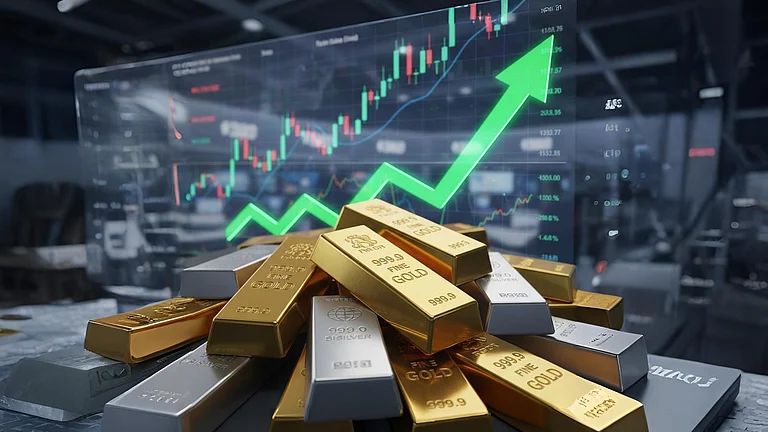
The yellow metal delivered nearly 60 per cent returns year-to-date (YTD) as of December 5, 2025, far outpacing domestic equities and bonds.
Meanwhile, the widely tracked equity benchmark index, Nifty 50, yielded 10.30 per cent returns, the broader Nifty 500 rose just 6 per cent, while in the debt market, the benchmark India 10-year G-sec index delivered negative returns, with yields declining more than 4 per cent.
What Fuelled The Gold Rush In 2025
Gold’s unparalleled rally this year has come from a complex mix of geopolitical tension, policy changes and a clear shift in investor behaviour. Central banks across the globe kept adding to their reserves, and gold-backed exchange-traded funds (ETFs) saw continuous inflows.
Conflicts in West Asia, trade tensions triggered by US President Donald Trump and the war in Ukraine have kept markets unsettled for most parts of the year.
Historically, gold tends to outperform during periods of conflict, market uncertainty, or financial stress, and this year has followed that pattern.
Persistent concerns over high inflation and a slowdown in global economic growth have also supported the rush for gold. Central banks, particularly US Federal Reserve and the Reserve Bank of India (RBI), turned more dovish this year and revised their interest rates downwards several times. That shift in monetary policy made the metal more appealing as a hedge at a time when confidence in other asset classes has been tested.
Further, weakness in the dollar made gold more affordable for global investors, while the rupee’s recent depreciation also pushed domestic gold prices higher.
Physical Gold Demand Slowed, But Remained Steady
Demand for gold jewellery softened due to high prices, however, investment-led physical buying continued to stay resilient. “Jewellery buyers are definitely feeling the pinch, especially for discretionary purposes,” said Ravi Singh, chief research officer, Master Capital Services. However, demand has not fallen off a cliff, he added.
“For weddings and essential occasions, people are still buying, though in smaller quantities. Many have simply adjusted their budget rather than exited the market,” Singh added.

Ross Maxwell, global strategy lead at VT Markets said consumers are gradually getting used to higher price levels, and gold’s steady appreciation through multiple cycles has created the belief that “higher for longer” might be a structural trend. Rather than a sharp drop in buying, he argued, demand is simply shifting in character, with “investment-led” purchases now driving the market more than jewellery.
Maxwell added that coins, bars and smaller denominations are still being bought, as consumers increasingly see gold as a financial asset rather than a luxury item.
Should You Buy Gold At Current Level
Gold futures on the Multi Commodity Exchange (MCX) touched a record high of Rs 1,31,685 per 10 grams on October 20, and as of the previous session, December 5, Gold futures last quoted at Rs 1,30,419 per 10 grams.
With gold prices near all-time high, investors are facing a timing dilemma. Is the metal still investible at current levels, or should they wait for a correction?
Singh cautioned that making a large lump-sum allocation at current levels carries clear timing risk. “Some correction cannot be ruled out,” he said, adding that waiting endlessly for the perfect dip is not practical.
He advised that systematic or staggered buying helps reduce the impact of price swings and removes the stress of timing the market.


Gold, he said, should be seen as a portfolio hedge and a stabilising asset rather than a short-term return generator.
Maxwell said, gold is often held for long-term stability and diversification rather than quick returns.
“If you are a long-term investor who wants diversification, buying using dollar cost averaging strategies, even at these elevated levels, can work. However, if you seek the best possible entry point or have a low-risk appetite, you may choose to wait for a pullback and use a ‘’buy the dip’’ strategy,” he said.
Maxwell added that gold often consolidates after sharp rallies, but warned that if the goal is to hedge uncertainty, delaying purchases for too long could work against investors.





