







Summary of this article
RBI kept repo rate at 5.25 per cent, raised FY27 growth forecast
Realty and auto stocks gained as markets welcomed the policy decision
Analysts expect earnings and global cues to drive markets ahead
The Reserve Bank of India (RBI) on August 5 kept the repo rate unchanged at 5.25 per cent, in line with market expectations. The Monetary Policy Committee (MPC) unanimously voted in favour of the status quo. The MPC retained its "neutral" stance, signalling that future policy decisions will continue to depend on incoming inflation and growth data rather than any pre-set rate path.
The decision marks the fourth consecutive policy review in which the MPC has left the benchmark repo rate unchanged after a cumulative 125-basis-point reduction in the previous easing cycle.
RBI Governor Sanjay Malhotra said the ongoing conflict in West Asia continues to disrupt key trade routes and pose risks to the global economy. Despite the global headwinds, the RBI raised its FY27 real gross domestic product (GDP) growth forecast by 10 basis points to 6.7 per cent and lowered its inflation forecast by 10 basis points to 5 per cent, citing stronger-than-expected economic activity in the April-June quarter. However, he cautioned that inflation is likely to peak in the September quarter, driven largely by food and fuel prices, while a deficient monsoon remains a key risk to the outlook.
Realty, Auto Lead Gains As Markets Welcome Growth Upgrade
Equity markets welcomed the RBI's decision to maintain the status quo, with investors taking comfort from the higher growth forecast and lower inflation projection.
Realty and auto stocks, which are among the most sensitive to changes in borrowing costs, outperformed after the RBI refrained from signalling any immediate tightening in monetary policy.
The Nifty Realty index rose around 2.40 per cent, while the Nifty Auto index gained about 1.50 per cent. Banking and financial stocks, however, traded with limited gains as investors assessed the RBI's commentary on inflation and growth.
Among realty stocks, Godrej Properties, DLF, Oberoi Realty, Lodha Developers, Sobha Realty and Prestige Estates traded higher, while Bosch, Sona BLW Precision Forgings, Ashok Leyland, Hero MotoCorp and Samvardhana Motherson led gains in the auto pack.

Bond Market Cheers Lower Inflation Outlook
The bond market also reacted positively to the policy announcement. The benchmark 10-year government bond yield eased around 3.30 basis points to 6.78 per cent as investors took comfort from the RBI's lower inflation forecast and unchanged policy stance. Bond yields move inversely to prices. The decline suggests investors increased their purchases of government securities after the RBI maintained policy stability and lowered its inflation forecast.
Abhishek Bisen, head fixed income at Kotak Mahindra AMC, said the lower inflation projection and higher growth forecast reinforced macroeconomic stability. He added that the governor's data-dependent approach, comfortable system liquidity and recent RBI measures have kept government bond yields favourable. "In the next three to six months, while the yield curve is steep, we expect the yields to remain range-bound," he said.
Akshat Garg, head of research and product at Choice Wealth, also said the policy "removes the risk of an immediate policy shock and reinforces macroeconomic stability," a factor that could continue to support fixed-income markets.
The absence of any policy surprise helped keep the rupee stable, with investors now awaiting fresh global cues and crude oil prices.
Rupee Holds Firm On Stable Policy Outlook
The rupee also strengthened after the policy announcement, with the USD/INR pair falling 0.18 per cent to 95.205. The domestic currency found support as the RBI's decision matched market expectations and reinforced confidence in India's macroeconomic outlook.
Ravi Singh, chief research officer at Master Capital Services, said the RBI's steady policy stance, along with a recovering rupee, adds to the sense of stability for investors. However, he noted that foreign portfolio investment (FPI) flows will continue to depend on broader global factors rather than the policy decision alone.
Garg echoed a similar view, saying a "predictable and credible central bank strengthens India's macroeconomic narrative," which supports long-term foreign capital allocation. "Policy stability may not create immediate inflows, but it certainly reinforces investor confidence," he said.
Analysts See Stability, Not Surprises
For market participants, however, the bigger takeaway was not the unchanged repo rate but the RBI's assessment of inflation, growth and future policy direction.
Garg said the policy reinforced the RBI's credibility by balancing inflation risks with confidence in growth. Singh said the higher FY27 GDP forecast reflected stronger domestic demand despite global uncertainties, though food prices, crude oil and the monsoon remain key risks. Bisen described the higher growth forecast and lower inflation projection as the policy's biggest positives, while Pranay Aggarwal, director and CEO at Stoxkart, said the RBI had adopted a "wait-and-watch" approach until there is greater clarity on the monsoon, energy prices and geopolitical developments.
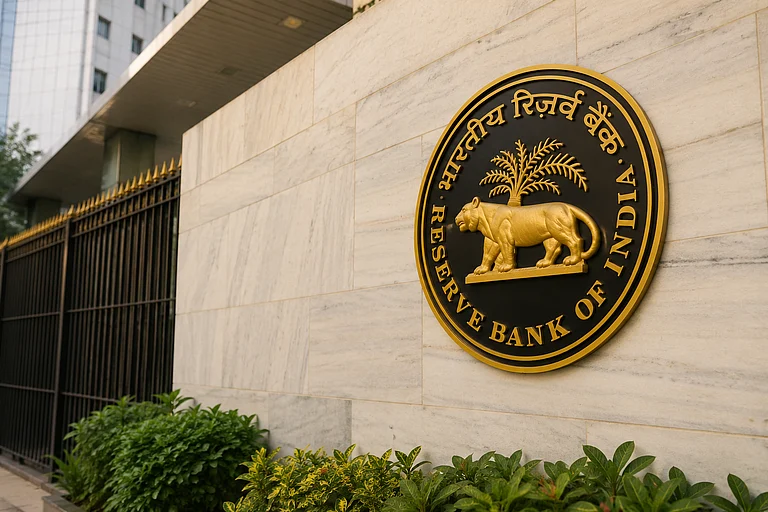
RBI Walks The Tightrope Between Inflation And Growth
The analysts broadly agreed that the RBI has avoided taking sides in the inflation-versus-growth debate, choosing instead to remain data-dependent as global uncertainties persist.
Garg said the central bank has "chosen neither inflation nor growth" and is "balancing both objectives carefully" while remaining watchful of inflation risks.
Bisen also believes the policy reflects a balanced approach. He said the upward revision in growth and the lower inflation forecast suggest the RBI is comfortable with domestic macroeconomic conditions and is more focused on external risks stemming from the West Asia conflict and global markets.
Singh said the RBI continues to view the recent rise in inflation as largely supply-driven and will closely monitor whether it spills over into core inflation.
Aggarwal, however, said the central bank has "temporarily tilted its primary focus toward inflation management," arguing that resilient domestic growth has given policymakers room to keep rates unchanged while preventing inflation expectations from becoming unanchored.
Markets May Now Shift Focus To Earnings
Despite the revised projections, analysts do not expect the policy to materially change the outlook for equities over the next three to six months.
Garg said "Today's policy removes the risk of an immediate policy shock and reinforces macroeconomic stability. Over the next three to six months, market direction will be driven more by corporate earnings, global liquidity, crude oil prices and geopolitical developments than by domestic interest rates."
Describing the RBI policy as "not a big shift, but a mildly positive one," Singh said the policy strengthens the earnings outlook, but cautioned that crude oil prices, the rupee and the West Asia conflict could limit any immediate re-rating in equities.
Aggarwal said the policy reinforces "a range-bound to constructively selective outlook." With the rate pause already priced in, he said corporate earnings and sector-specific fundamentals, rather than monetary policy, are likely to drive markets over the next few quarters.
FPI Flows Still Depend On Global Factors
On foreign investment, analysts said today's policy is unlikely to trigger immediate foreign portfolio investor (FPI) inflows, though it strengthens India's macroeconomic narrative.
Garg said "Policy stability may not create immediate inflows, but it certainly reinforces investor confidence."
Singh said policy stability and a stronger growth outlook improve India's relative appeal among emerging markets, although global interest rates and currency movements will remain the key drivers of foreign flows.
Aggarwal said the policy provides a supportive macroeconomic foundation, but sustained FPI inflows will depend on global liquidity, US Federal Reserve policy and domestic reforms rather than the RBI's decision alone.


As the policy offered few surprises, investors are likely to look beyond interest rates and focus on earnings, inflation trends, crude oil prices and global developments to gauge the market's next move.





