





Summary of this article
Rising property prices, a sweeping infrastructure push and the emergence of Jewar as a new economic node are positioning the Noida–Greater Noida belt as one of the NCR’s most significant growth corridors.
The change is already showing up in property values. According to Anarock, average residential prices in Noida increased by 125 per cent between 2019 and Q2 2026, from Rs 4,795 per sq ft to Rs 10,780 per sq ft.
As these infrastructural milestones come to life, Noida–Greater Noida is moving from an affordability-led housing market towards a more integrated urban and economic corridor.
For years, Noida and Greater Noida were positioned as affordable alternatives to Delhi and Gurugram. That equation is changing rapidly. Rising property prices, a sweeping infrastructure push and the emergence of Jewar as a new economic node are reshaping the region’s real estate landscape, positioning the Noida-Greater Noida belt as one of Delhi-National Capital Region’s (Delhi-NCR’s) most significant growth corridors.
The change is already showing up in property values here. According to Anarock, average residential prices in Noida have increased by 125 per cent between 2019 and Q2 2026, from Rs 4,795 per sq ft to Rs 10,780 per sq ft. The price growth in Bengaluru and Gurugram was lower. But while price appreciation has put the region firmly on the radar of buyers and investors, the next phase of growth is likely to be determined as much by infrastructure as by housing demand.
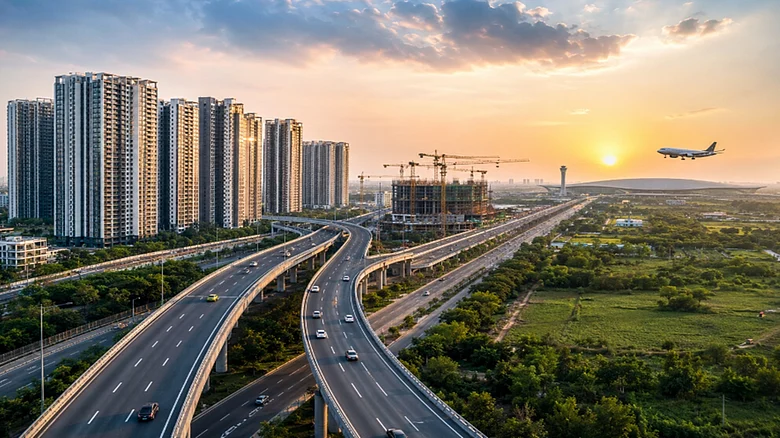
Connectivity is emerging as a critical determinant of real estate value across the Noida-Greater Noida belt. Among the most significant interventions is the proposed 50-km, eight-lane elevated road from Noida Sector 94 towards Greater Noida and the Yamuna Expressway, with its alignment extending closer to the Noida International Airport at Jewar. Estimated at Rs 4,000 crore, the corridor is planned to provide an alternative to the Noida-Greater Noida Expressway, absorb additional airport-related traffic, as well as strengthen links between corporate, residential, and emerging development zones, as well as the Faridabad-Jewar Greenfield Expressway.

The connectivity story extends further west. The proposed 74.467 km, Rs 8,585-crore Jewar Airport-Ganga Expressway link could create another important east-west transport spine by connecting the Yamuna Expressway region with the Ganga Expressway near Syana in Bulandshahr. By strengthening links between the Jewar-Greater Noida belt and the wider western Uttar Pradesh road network, the project could expand the region’s economic and industrial catchment.
For real estate, the implications could be significant. Better access to Jewar, Greater Noida and emerging industrial and logistics clusters could accelerate development along the wider corridor, while the construction of the greenfield expressway and the resulting project pipeline could create sustained demand for construction equipment and allied infrastructure capabilities.
Meanwhile, Greater Noida West is seeing its own infrastructure push. The proposed double-decker flyover through the Shahberi corridor is expected to cost around Rs 900 crore and will connect 130-metre road in Greater Noida West to Shahberi, Crossings Republik and NH-9. The project will help decongest the area by improving flow between these fast-developing residential clusters to the bigger Delhi-NCR road network. Emerging micro-markets are more accessible for homebuyers and developers.
Ashish Agarwal, director, AU Real Estate, says, “The real estate market in Delhi-NCR is increasingly shaped by connectivity-led growth, with infrastructure corridors determining where residential demand emerges next. Noida and Greater Noida stand out for combining planned urban development with improving connectivity to Delhi, Gurugram and other employment hubs in Delhi-NCR. As new expressways, elevated corridors and airport-linked infrastructure take shape, the once-peripheral locations are becoming more accessible and commercially viable, boosting established micro-markets while opening new residential corridors along the way. Over the medium- to long-term, this convergence of connectivity, employment and infrastructure should support both end-user demand and sustained value creation for investors.”
If these infrastructure projects are changing how people access the region, the Jewar International Airport is changing the geography of opportunity itself. The airport is expected to anchor a wider economic corridor spanning logistics, manufacturing, hospitality, commercial, and residential development. The Yamuna Expressway Industrial Development Authority (YEIDA) is also planning a broader ecosystem around the airport, including a medical hub, pharmaceutical cluster, university township, Taiwan City, stadium and interstate bus terminal.
The emergence of these employment and commercial nodes could be particularly important for residential real estate. Job creation, business activity and supporting infrastructure can provide the basis for sustained housing demand across the wider corridor, rather than creating short-term speculative interest. This infrastructure-driven change is also taking place alongside another structural change – the premiumisation of Greater Noida. With property prices rising in Noida, and land availability tightening, developers are increasingly looking towards Greater Noida and the Yamuna Expressway for larger homes, better amenities, and premium housing projects.
Yash Garg, director, M3M Noida, says, “Infrastructure in Noida and Greater Noida is no longer a future promise. It is actively shaping housing demand, buyer preferences, and the evolution of new micro-markets. The airport, new road corridors, and expanding connectivity are changing how homebuyers evaluate locations across Delhi-NCR. With improved access to employment centres, commercial districts, and social infrastructure, buyers are increasingly willing to look beyond Noida and towards emerging destinations offering larger homes and stronger long-term potential.”
These developments are not just changing individual housing projects; they are also reshaping the way Delhi-NCR is growing. The recently approved Delhi Master Plan 2047, with its focus on better mobility, planned development, housing and regional connectivity, is expected to further strengthen links between Delhi and the surrounding cities. In this emerging framework, Noida and Greater Noida are increasingly being viewed not as peripheral extensions of Delhi, but as interconnected residential, commercial, industrial and transport nodes within a larger regional economy.
Aayush Raj, chief of staff, Rodic Consultants, says, “The proposed Jewar Airport-Ganga Expressway link is a significant step towards building an integrated, multimodal infrastructure ecosystem in western Uttar Pradesh. Such large-scale connectivity projects do much more than reduce travel time; they create the backbone for new economic corridors by linking airports, expressways, industrial clusters and emerging urban centres. By connecting Jewar Airport with the Yamuna Expressway, Ganga Expressway, NH-9 and the emerging New Noida region, the project can unlock new opportunities for industrial development, logistics, warehousing and real estate across the region.”
From an infrastructure perspective, projects of this scale also generate a multiplier effect across the construction ecosystem. The development and subsequent expansion of roads, industrial parks, logistics hubs and urban infrastructure will drive sustained demand for construction equipment, engineering services, and technology-led project solutions. More importantly, improved connectivity can encourage private investment and enable businesses to expand beyond established urban centres.


Says Raj: “This creates a virtuous cycle of infrastructure creation, investment, employment and economic activity. As India continues to strengthen its infrastructure backbone, such integrated regional connectivity projects will be critical in translating public infrastructure spending into long-term, broad-based economic growth.”
As these infrastructural milestones come to life, Noida-Greater Noida is moving from an affordability-led housing market towards a more integrated urban and economic corridor. Its next phase of growth will be shaped not just by how many homes are built, but by how well infrastructure, employment, commerce, and social services work together to create a connected and sustainable city.





