







Summary of this article
Allahabad High Court orders SBI to refund Rs 17.29 lakh to the widow.
The bank had debited the deceased husband's loan from the insurance proceeds received by the widow.
The Court held that insurance money belongs to the beneficiary, not the deceased estate.
A bank cannot simply recover the loan from a deceased person’s surviving family member’s account without authorisation. In a recent hearing, the Allahabad High Court has directed the State Bank of India (SBI) to refund around Rs 17 lakh (Rs 17,29,999) to a widow while safeguarding the financial rights of the surviving dependents of the deceased. A Division Bench comprising Justice JJ Munir and Justice Indrajeet Shukla held on a prima facie basis that financial institutions cannot recover an unpaid loan borrowed by a deceased from the life insurance benefits of a surviving spouse.
The matter began after the deceased’s widow filed a writ petition following the death of her husband, who died in a road accident on June 7, 2025. The husband was employed as the headmaster of a primary school in Balipur, Chail, Kaushambi.
After his demise, the petitioner received Rs 50 lakh as proceeds from a life insurance policy, which was credited to her savings bank account in an SBI branch in Prayagraj. However, SBI deducted Rs 17,29,999 from her account to recover the remaining part of the personal loan taken by her late husband.


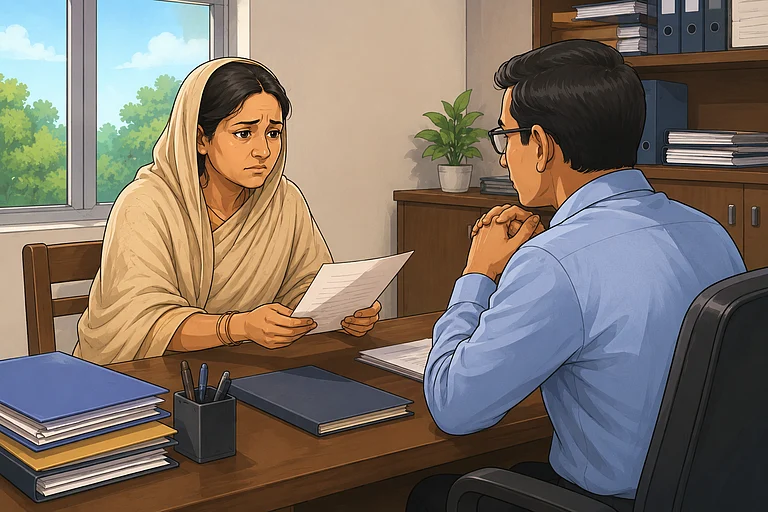


As she had not authorised this payment, she approached the high court. She contended that this was a unilateral debit from her account, and thus, it was an unauthorised transaction. She also informed that she was neither a co-borrower nor a guarantor for her husband’s personal loan.
On the other hand, the bank defended its action by arguing that its action was in accordance with Clause 18(iii) of the loan agreement executed between SBI and the deceased borrower.
The high court observed that while Clause 18 (iii) was very broadly framed, it didn’t prima facie authorise SBI to recover the amount from life insurance proceeds received by the widow. It noted that the clause was widely worded and gave a paramount right of set-off and general lien to the bank over monies, accounts, securities, and other assets belonging to or standing to the credit of the borrower.

The court explained that insurance proceeds become due only after the death of the insured person and are never owned by the deceased person during his/her lifetime. Therefore, such funds are not the deceased’s property or estate that is passed on to the legal heirs. Instead, insurance proceeds are the exclusive property of the beneficiaries acquired as a social security measure.
The court held that prima facie SBI has no right to recover the loan dues from the insurance payout.
It granted the respondent (the bank) two weeks to file a counter affidavit, and set the next hearing for October 7, 2026. The Bench also issued an interim mandamus (a court order that commands a government official, public institution, or a lower court to perform a duty they are legally required to do) to the senior manager at the SBI Regional Office, Johnstonganj, Prayagraj, and the branch manager of the SBI Colonelganj Branch to ensure immediate refund of the Rs 17,29,999 deducted to the petitioner’s account.

The court held that either the bank officials refund the amount or file a separate personal affidavit within two weeks to show why this directive should not be made permanent.
The next hearing will be after two weeks on October 7, 2026.





