







Summary of this article
RBI data shows a sharp rise in bank deposits over the year.
Total deposits grew over 12 per cent year-on-year as of May 15, 2026.
Time deposits outpaced demand deposits.
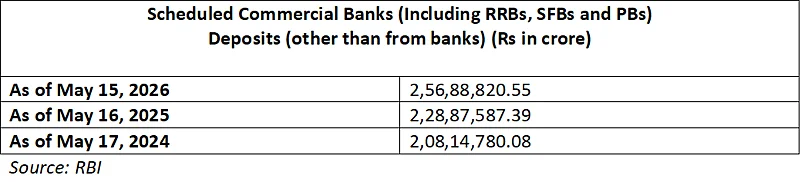
The constant volatility in the market makes investors jittery and leads them to look for safer avenues. This holds for bank deposits as per the Reserve Bank of India (RBI) data. The bank deposits have grown over 12 per cent over one year and stood at Rs 256.9 lakh crore as of May 15, 2026, compared to Rs 228.9 lakh crore as of May 15, 2025. The growth in total deposits year-over-year as of May 15, 2026, is higher (12.2 per cent) compared to around 10 per cent (9.96 per cent) annual growth in deposits as of May 16, 2025. Let’s delve deeper and check deposit growth over the last three years.
Scheduled Bank Deposit Over The Last Three Years




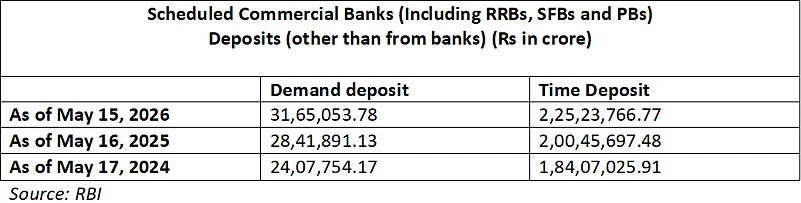
However, within the bank deposits, which include demand and time deposits, time deposits (fixed deposits, recurring deposits) recorded higher growth. These grew from 12.36 per cent YoY as of May 15, 2026, compared to 8.90 per cent in the corresponding period in the previous year, as of May 16, 2025.
Scheduled Bank Demand And Time Deposit Growth Year-Over-Year

Investors Are Shifting To Fixed Deposits
RBI’s Annual Basic Statistical Return report also highlights a similar trend. It shows that scheduled commercial banks’ deposits grew 11.5 per cent YoY, as of March end 2026, compared to 10.6 per cent growth the previous year.
But it also underscores that savers are not just shifting their funds to bank deposits; they are shifting them even from their savings accounts to higher interest-yielding FDs. The data reveals that FDs are gaining attention again.
As per the report, the share of savings deposits in the overall deposits has been steadily declining. It has dropped from 34.6 per cent in 2022 to 28.7 per cent in March 2026. But at the same time, deposits in FDs have increased from around 55 per cent to over 61 per cent. Within the FDs, deposits in ‘one to three years’ tenure FDs have risen from 50.4 per cent in March 2022 to 69.8 per cent in March 2026.
The data reflects the shift in savers’ preferences. They now prefer higher and guaranteed returns in place of quick liquidity.
Another reason for shifting to fixed deposits could be continuous market volatility.

Volatile Market Remains The Key Factor
Vineet Agarwal, Co-Founder, Jiraaf, a SEBI-registered Online Bond Platform Provider (OBPP), says, “This shift is not because FD rates are highly competitive, but because fixed deposits offer predictability. Over the past two years, equity markets have largely remained range-bound, with bouts of volatility driven by global rate movements, inflation concerns, geopolitical tensions, and uneven growth expectations. Because of this, many investors are looking to protect part of their capital in instruments that provide certainty.”
The move is more of a portfolio rebalancing after a continuously prevailing uncertainty in the market. Depositing in bank deposits is a diversification approach as investors prefer stability. FDs are a simple, traditional instrument to keep money safe and growing.

“For conservative investors, senior citizens, and households with near-term financial goals, FDs become attractive when market-linked products do not offer consistent short-term visibility. So, this is both diversification and a response to market fatigue. The pace of FD inflows may moderate if equity markets regain strong momentum or if deposit rates decline. However, the broader preference for predictable income and lower volatility is likely to continue.”
As the market remains unstable, FDs offer guaranteed returns and, more importantly, the predictability of income. This is why they are gaining investors’ attention.





