Summary of this article
EPFO attached ANU's bank accounts over Rs 6.35 crore PF default.
One should check EPF passbook and salary slips regularly to ensure regular deposits to EPFO.
File grievance if deposit is not made.
If an employer doesn’t deposit your employee's provident fund, what would you do? In one such case, the Employees’ Provident Fund Organisation (EPFO) has attached banks accounts of Acharya Nagarjuna University (ANU) for defaulting on EPF contribution of Rs 6.25 crore, despite reminders. Per the New India Express report, the University defaulted on depositing the contribution of daily wage employees, contractual and outsourced employees, and security staff for the period between 1992 and 2017. When the matter came to EPFO’s notice, it enquired and found that around 440 employees were not enrolled under the social security scheme. EPFO determined a financial liability (the dues to be paid by the University towards these employees’ social security) at Rs 6.35 crore. However, the university didn’t pay the amount, and thus EPFO recovered around Rs 5 crore by attaching its bank account, and Rs 1.35 crore are yet to be recovered.
In such non-deposition cases, where employers don’t enrol employees under the EPFO schemes, or do not deposit the contribution with the EPFO, this eventually results in a loss to the employees.
Pratik Vaidya, Labour-law and Social-Security Advisor, CVO, Karma Management, says, “Once an employer deducts EPF from an employee’s wages, it is legally bound to deposit it with EPFO. Retaining or diverting deducted EPF is considered misappropriation of trust money. Under Section 14 of the EPF Act, such offences are punishable with imprisonment and fines, and in aggravated or willful cases, arrest without warrant, since these are treated as cognisable economic offences.”

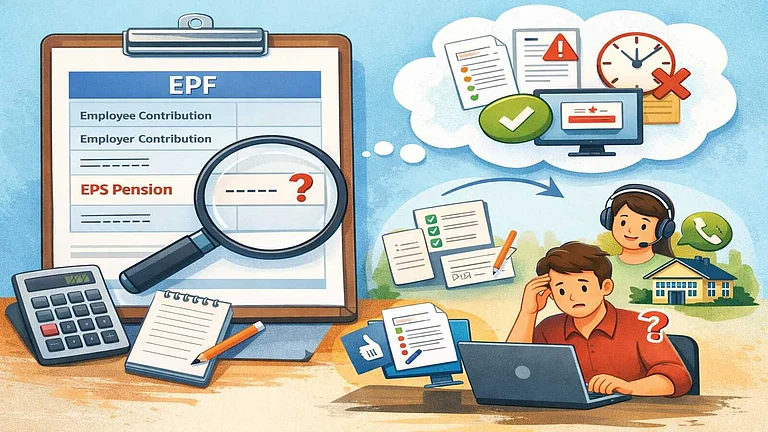


However, at last, any gap in contribution or no contribution means loss of interest, less pension, and less retirement corpus for employees. And this loss matters.
“A missed PF contribution of Rs 4,000 per month over 7 to 8 years can reduce retirement savings by Rs 9 lakh to Rs 11 lakh due to lost compounding. Further, EPS pensionable service for those years may also be diluted,” Vaidya says.

How To Ensure That EPF Contribution Is Reaching The EPFO?
EPFO mandates a contribution of 12 per cent of the salary by the employee and a matching amount by the employer towards the employee provident fund (EPF) and employee pension scheme (EPS). Employers deduct employees’ share from salary payment and add their part to deposit it to the EPFO.
To ensure that contributions are deposited to EPFO timely and regularly, employees should monitor their EPF account balance and match it with the salary slip. To know how to check the EPF balance, read here.
Note that the internet is not mandatory to check the balance. One can do it offline, too, without internet connectivity.
However, Vaidya highlights that these services works only when the UAN is activated, mobile number is updated, Aadhaar is seeded with UAN, and KYC (Aadhaar, PAN, bank account) is completed and approved.”
But what if employers fail to deposit or intentionally don’t do it?

What Should Employees Do If The EPF Contribution Doesn’t Reach EPFO?
Says Ketan Das, Business Head, FinRight Technologies: “If employees find a delay and no contribution, they can file an official grievance through government redressal services. They can visit EPFO’s regional office in-person to get information related to the contribution deducted and deposited. They can also even raise RTI (Right to Information) requests and seek details on the same.”
Here is what employees can do.
Check With Employer
In case there is a mismatch in the contribution and the deposit in the account, check with the employer to clarify the reason for the discrepancy.
Lodge A Complaint
If there is no satisfactory answer, lodge a complaint on the ‘EPFiGMS’ grievance portal of the EPFO. Read here to know how to lodge a complaint on EPFiGMS portal.
Legal Action
EPFO will enquire with the employer, and if found guilty, it can take legal action against such employers. It can attach bank accounts as it has done in the aforementioned university’s case, attach property, impose an interest penalty, etc.
EES-2025
Recently, the government has launched the Employees' Enrolment Scheme (EES) for six months, starting from November 1, 2025, to April 1, 2026. This is for employers who have not registered with the EPFO or haven’t enrolled all or some of their employees under the scheme. They can register with the EPFO under EES paying a nominal penalty of Rs 100. This is to encourage inclusion to ensure social security for more employees, and by providing incentives to employers.
The scheme is for both the new employers and existing employers who are already registered.
Das says, “Employers have their last chance to enrol their employees during this six-month scheme from November 1, 2025, to April 1, 2026. This is even valid for those who weren't enrolled in the EPF scheme earlier. Under the EES, employers need to pay only their share, along with interest and a nominal penalty of Rs 100 to enrol unregistered employees. This would ensure no further audit or penalties for this error.”
He adds that employees cannot recover their lost contribution years, but they become eligible for future contributions if their employers enrol them for EPFO schemes now under the EES campaign. “Employee can't take action on their lost opportunities as this scheme is for future fixing,” he says.
Vaidya seconds, saying, “This is a compliance-relief scheme for employers, not a restitution scheme for employees and lost years of EPF compounding cannot be recreated.”

Pending EPF Related Cases In Courts
Note that as of May 2025, there were over 6,000 litigations pending across various courts, including the Supreme Court, High Courts, and Central Government Industrial Tribunals (CGITs). The outstanding penal damage is expected to be more than Rs 2,400 crore in these cases. But it is not all, around 21,000 cases are estimated to be pending with the EPFO.
Lately, EPFO has brought several changes in the scheme to make it convenient for members, in terms of accessing the account, making withdrawals, transferring accounts, etc., but if the contribution itself doesn’t reach EPFO, all services are of no use.
While EPFO needs to work on its monitoring system, members (EPF subscribers) and eligible subscribers must keep an eye on whether their EPF deduction is reaching its destination or not.