





Summary of this article
Lifestyle upgrades typically become permanent expenses over time.
People upgrade lifestyle to show who they are to their peers and sometimes to themseves too.
They don't increase savings rate even if their income rises sharply.
By Bhuvanaa Shreeram
Priya and Suresh are 49. Between them, they earn Rs 42 lakh a year. They live well, a good home in Bengaluru, two cars, an annual holiday abroad, and their daughter in one of the better private schools in the city. They save less than 12 per cent of their income. And neither of them can quite explain where the rest goes.
When Suresh was 35 and earning Rs 18 lakh, he saved nearly 28 per cent of his income. He has a smaller flat, one car, and simpler holidays. Life was fine. Now, earning more than double, he saves less than half as much proportionally. Not because he is careless, but because the life they have built costs what it costs. There is no single line item that looks extravagant. It just all adds up.




What Suresh is experiencing has a name. I call it the Aspiration Tax.
What Is The Aspiration Tax?
The Aspiration Tax is not on your salary slip. It does not appear in your tax returns. But it is real, it is compounding, and for India's upwardly mobile middle and upper-middle class, it is likely the single largest drain on long-term wealth that nobody talks about.
Every time income rises, a promotion, a bonus, a business uptick, lifestyle adjusts upward to match. For example: a better school, a larger home, business class, just this once and then somehow always after that. None of these decisions is wrong. Each feels earned. But together, they form a ratchet that only turns one way. Up.
The critical distinction that financial content almost never makes: inflation is something that happens to you. Lifestyle inflation is something you participate in ‘willingly’, with the best of intentions. That is what makes it so much harder to see and so much harder to reverse.
Inflation taxes your wallet. The Aspiration Tax taxes your future. And unlike inflation, you volunteered for this one.

Why This Has Always Been a Middle-Class Problem
The financial media routinely gets this wrong. Inflation (the CPI headline number) was never really a problem for the poor. The poor have almost nothing to inflate. The real inflation story has always belonged to the middle and aspiring upper-middle class. For this group, inflation has two engines running simultaneously:
Price inflation on things they already consume, like fuel, school fees, healthcare, dining, and housing.
Lifestyle inflation is driven by aspiration, such as the continuous, socially reinforced upgrade cycle that income growth enables and peer groups normalise.
The second engine is far more powerful than the first. And it accelerates exactly when people are doing well—hitting hardest in the 40s and early 50s, when careers are at their peak, and the temptation to finally live well feels not just reasonable but deserved.
The Wheel That Only Turns One Way
The most dangerous feature of lifestyle inflation is not that it costs money. It is almost impossible to reverse.
Priya and Suresh's daughter is in a school that costs Rs 2.4 lakh a year. Moving her to a cheaper school is theoretically possible. In practice, it isn't actually impossible, but the social and emotional cost is too high. They live in a flat with a monthly maintenance of Rs 18,000. They could move somewhere cheaper. They won't.
Every upgrade, once made, becomes a baseline. Not a luxury but a necessity. The sum of a decade of such upgrades is what moves the monthly budget upward and saves potential downward.

The Ratchet In Numbers
At 35: Income Rs 18L/year → Savings rate 28 per cent → Monthly savings Rs 42,000
At 49: Income Rs 42L/year → Savings rate 12 per cent → Monthly savings Rs 42,000
Same rupee amount saved. Effectively, only half the proportional wealth is being built. The ratchet won.
The tragedy is not that Suresh earns less; he earns far more, but it is his wealth-building rate that has not moved in 14 years. The Aspiration Tax consumed most of his income growth.
What This Does To Your Retirement
When Suresh retires at 58, he will need to fund a lifestyle that costs approximately Rs 2.5 lakh per month today. At 6 per cent inflation, that is Rs 4.5 lakh per month at retirement. To fund that for 25 years, at a 7 per cent return, Suresh needs a retirement corpus of approximately Rs 7.2 crore.
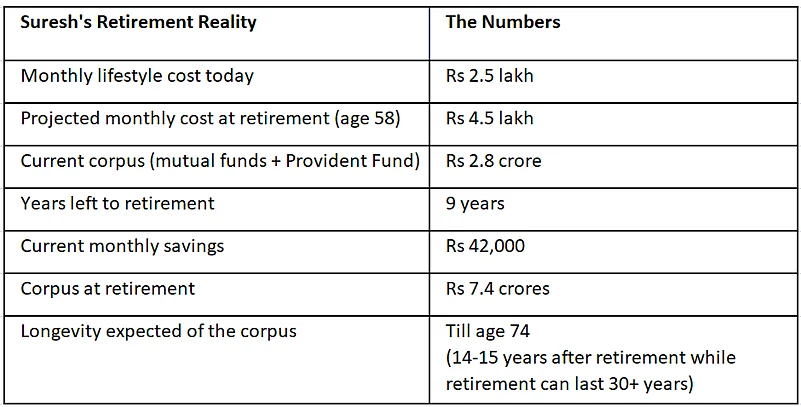

Suresh is not in trouble because he earns too little. He is in trouble because his lifestyle has made his retirement expensive, and his savings rate has not kept pace with either his income or his ambitions.
When I show clients this table for the first time, they go quiet. Most people have never run this calculation against their actual lifestyle costs. They have a vague corpus target in mind, completely disconnected from what their life actually costs today and, more importantly, will cost in retirement.
Three Ways To Start Reclaiming The Tax
This is less about deprivation and more about being intentional. The goal is never to stop aspiring for a better life. But it is to aspire with eyes open and knowing what each upgrade costs in future wealth.
1. Apply The 50 Per Cent Rule To Every Income Increase
Every time income rises (bonus, increment, new role), commit 50 per cent of the increase to savings before lifestyle has a chance to absorb it. The lifestyle will expand to whatever is available. So make it less available. This single rule, applied consistently, would have meant Suresh was saving Rs 1.1 lakh a month today instead of Rs 42,000.

2. Calculate The Retirement Cost Of Every Major Lifestyle Upgrade
Before making a significant recurring upgrade, calculate what it adds to your monthly cost floor, then calculate how much additional retirement corpus it requires.
The True Cost Formula
Every Rs 10,000/month added to your lifestyle cost floor = approximately Rs 29 lakh in additional retirement corpus needed. Before the next upgrade, ask: Do I have this covered?
3. Build Your Wealth Identity Before Your Lifestyle Identity
The deepest driver of lifestyle inflation is not greed. It is identity. We upgrade to signal who we are, to our peers and sometimes to ourselves too. The people who win this game are not the ones who earn the most. They are the ones who, at every income level, deliberately choose how much of their earnings to keep, and protect that number with the same intensity they protect everything else they care about.
The goal isn't to want less. It's to know exactly what wanting more is costing you and to decide that consciously, not by default.
Back To Priya and Suresh
They are not in crisis. They have time. But the time is now, not at 54, when the gap becomes harder to close, and not at 58, when it may be too late.
The Aspiration Tax does not announce itself. It arrives in increments, each one reasonable, each one deserved, and each one permanent. The only way to see it clearly is to run the numbers honestly against your actual life and your actual retirement ambitions, not a generic target.
If this hit close to home, you probably know someone it will hit even closer. Send it to them.
The author is a certified financial planner and co-founder and head of financial planning at House of Alpha Investment Advisors Private Limited.
This article is for informational purposes only and does not constitute investment advice. All figures used are illustrative. Tax laws are subject to change; please consult a qualified tax advisor for personalised guidance.
(Disclaimer: Views expressed are the author’s own, and Outlook Money does not necessarily subscribe to them. Outlook Money shall not be responsible for any damage caused to any person/organisation directly or indirectly.)





