






Summary of this article
Sebi proposed allowing mutual fund investments through salary deductions
The regulator also proposed MF unit-based payouts for MF distributors and donations through MF schemes
Strict KYC and anti-money laundering safeguards will continue under the proposed framework
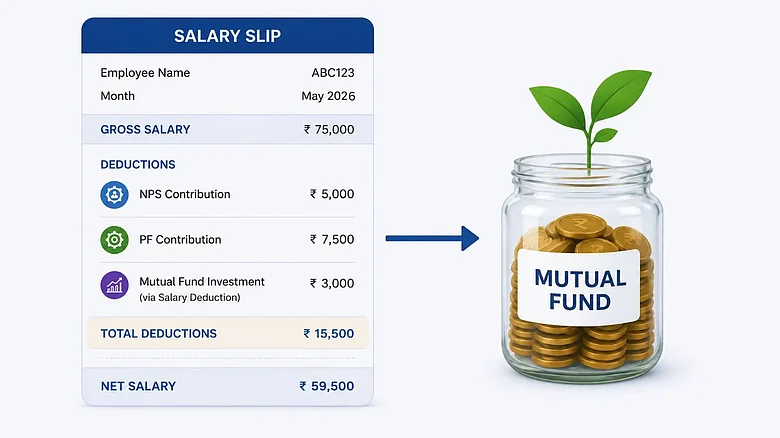
Employees may soon be able to invest in mutual funds directly through salary deductions, similar to Provident Fund (PF) and National Pension System (NPS) contributions, if the Securities and Exchange Board of India’s (Sebi) latest proposal comes into effect. The market regulator has proposed easing certain mutual fund payment rules to allow salary-based investments, commission payouts to distributors in mutual fund units, and donations towards social causes through mutual fund schemes.
At present, mutual fund investments can only be made from an investor’s own bank account. Sebi said the proposal aims to “strike a balanced approach that facilitates ease of investing in genuine cases while reinforcing robust safeguards against potential misuse.”
The regulator has invited public comments on the proposals till June 10, 2026.
Mutual Fund Investments Through Salary Deductions
One of Sebi’s key proposals is to allow employers to invest in mutual funds on behalf of employees through salary deductions, much like PF and NPS contributions.
The regulator said the facility would be available to listed companies, EPFO-registered firms, and asset management companies (AMCs) themselves. However, only employees who voluntarily opt for the arrangement would be included.
“Such facility would be available to all listed and EPFO registered companies and the AMCs themselves and only interested employees may opt for such an arrangement and agree for salary deduction for MF schemes of their choice,” Sebi said.
According to the regulator, the proposal recognises the common practice of employers offering savings and investment benefits to employees and would allow AMCs to receive consolidated payments through payroll deductions.
Sebi has sought public feedback on whether companies should be barred from directing employees towards mutual fund schemes run by their own group AMCs to avoid possible conflicts of interest.
Mutual Fund Distributors May Soon Get Paid In MF Units
Sebi also proposed allowing AMCs to pay commissions to mutual fund distributors in the form of mutual fund units instead of cash. According to the regulator, this would give distributors a simple and disciplined way to invest in mutual funds and encourage long-term investing habits.
“The proposed scenario for allotment of MF units in lieu of trail commission or part thereof as agreed between the AMC and MFD shall provide a convenient, seamless and disciplined way of investing in MF units for the MFD and encourages the MFDs to save and invest for the long term,” Sebi said.
The facility would only be available to distributors registered with the Association of Mutual Funds in India (Amfi) and selling schemes of the respective AMC.
However, Sebi also raised concerns that such a system could lead to mis-selling if distributors start favouring schemes that offer unit-based commissions. The regulator has sought public feedback on whether this could create conflicts of interest and what safeguards should be introduced to prevent misuse.
Mutual Fund Investors May Soon Be Able To Support NGOs Directly
Further, the regulator proposed allowing investors to donate a part of their mutual fund investment or returns towards social causes through a regulated framework.
Under the proposal, investors could contribute either through Zero Coupon Zero Principal (ZCZP) instruments issued by not-for-profit organisations (NPOs) registered on the Social Stock Exchange (SSE), or directly to selected NGOs.
“Enabling donations through Mutual Funds will eliminate the operational difficulties and the burden on investors to independently identify credible Non-Governmental Organisations (NGOs),” Sebi said.
The regulator has suggested two possible models. In the first option, a dedicated mutual fund scheme could be launched where investors can choose to donate a part of their dividend or redemption amount. In the second option, all existing mutual fund schemes could offer such a donation facility.
Sebi has also sought public feedback on whether donations should be allowed only to NPOs registered on the Social Stock Exchange.
Safeguards Against Money Laundering Risks
Sebi said strict anti-money laundering safeguards will continue despite relaxation in third-party payment rules.
The proposed safeguards include mandatory KYC checks, verification of the relationship between the payer and investor, written approvals, and electronic tracking of transactions. Dividend and redemption payouts will continue to go only to the investor’s verified bank account. Amfi, along with Sebi, will issue detailed operational guidelines for the framework.
Why Sebi Wants To Allow Third-Party Payments In Mutual Funds
Currently, mutual fund investments can only be made using the investor’s own bank account through Reserve Bank of India (RBI)-authorised payment platforms or Sebi-recognised clearing corporations.
According to Sebi, the mutual fund industry had requested relaxation in these rules for certain genuine cases, such as “payment of salaries by employers, payment of commissions by AMCs etc with adequate safeguards in place.”
“In view of strong regulatory framework for Indian mutual fund industry and based on representations received from the industry and Amfi, a need is felt to review the existing framework for third-party payments in Mutual Funds,” Sebi said in the draft circular.
Frequently Asked Questions
What has Sebi proposed regarding salary-based mutual fund investments?
Sebi has proposed allowing employees to invest in mutual funds through salary deductions, similar to Provident Fund (PF) and National Pension System (NPS) contributions. Under the proposal, employers would be able to facilitate mutual fund investments on behalf of employees who voluntarily opt for the facility.
Can employees soon invest in mutual funds directly through salary deductions like PF and NPS?
Yes, if Sebi’s proposal is implemented, employees of listed companies, EPFO-registered firms, and asset management companies (AMCs) may be able to invest in mutual funds directly through salary deductions. However, the facility will only be available to employees who choose to opt in.




What are Sebi’s proposed changes to third-party payments in mutual funds?
Sebi has proposed easing third-party payment rules in mutual funds to allow salary-based investments, mutual fund unit payouts for distributors instead of cash commissions, and donations through mutual fund schemes. The regulator said strict KYC and anti-money laundering safeguards will continue under the proposed framework.





