







Summary of this article
The 25X rule comes from US-based assumptions about inflation, which makes it less suitable for India.
Indian retirees may need a larger corpus, considering personal inflation, healthcare costs, and life expectancy.
A better retirement plan should factor in actual lifestyle costs, retirement income layers, and parental care expenses, instead of relying on a single universal multiplier.
By Bhuvanaa Shreeram
Deepa is 48. She is a senior manager at a large pharmaceutical company in Chennai, earns well, and has been telling herself for years that she needs ‘about 25 times her annual expenses’ saved before she can retire. She read about it somewhere—maybe a financial blog or a magazine or maybe a colleague mentioned it—and it has become the number she measures herself against.
At her current savings rate, she will ‘hit’ that number at 57. She has a target and a plan to reach it. She feels she is on track. She is not.




The 25X rule was not designed for her. It was not designed for India. Applied to her specific situation (her inflation environment, her family structure, her retirement horizon), it will likely leave her significantly underfunded.
Where The 25X Rule Comes From
The 25X rule comes from a 1994 US study by financial planner William Bengen. He looked at historical US market data and concluded that a retiree could withdraw 4 per cent of their portfolio annually—adjusted for inflation—and have a very high probability of the money lasting 30 years. If you withdraw 4 per cent per year, you need 25 times your annual expenses saved. Hence: the 25X rule.
Simple, easy to understand and based on US stock market returns, US inflation, US tax structures, and a 30-year horizon calibrated to life expectancy data of the US from the early 1990s.
Every single one of those inputs looks different in India in 2026.
A rule built on American data and American life expectancy is not a retirement plan for India. It is a starting point that needs significant adjustment.
Why 25X Underestimates Your Number In India
Let me walk you through where the assumption breaks down.
India’s inflation is structurally higher. The 4 per cent rule was based on US inflation, which has historically averaged around 2.5–3 per cent annually. India’s consumer price index (CPI) inflation has averaged closer to 6–7 per cent over the past two decades, but for the actual consumption basket of an upper-middle-class household, taking into account healthcare, education, dining, domestic help, and lifestyle services, it runs considerably higher than headline CPI.
At 3 per cent inflation, a 4 per cent withdrawal rate works because real returns comfortably exceed withdrawals. At 6–7 per cent inflation, the real return on a balanced portfolio is significantly compressed. A 4 per cent withdrawal rate starts eating into the corpus faster than most projections assume.
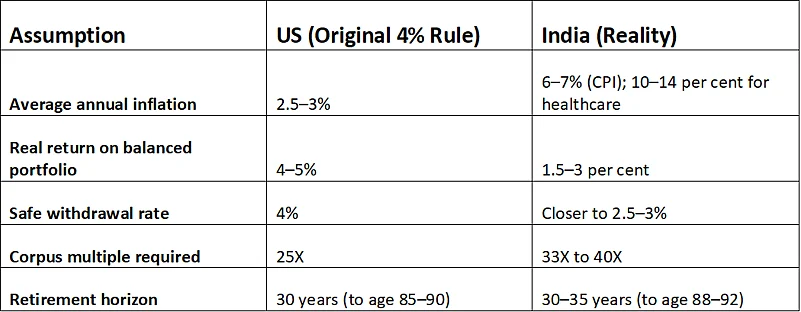

The implication is significant. If a safer Indian withdrawal rate is closer to 2.5–3 per cent, the corpus multiple required is not 25X, but 33X to 40X of annual expenses. For Deepa, that is not a minor adjustment. It is the difference between retiring at 57 with confidence and retiring at 57 with a plan that runs out of money in her late 70s.
Indians are also living longer. A 48-year-old woman today, in good health, in a metro, with access to quality healthcare, has a realistic probability of living well into her late 80s or early 90s. A retirement starting at 57 may need to fund 33 to 35 years, not 30. Every additional year adds to the corpus needed. And the later years are almost always the most expensive ones, when healthcare and support needs peak.

Factors That Give You Your Real Number
The 25X rule gives everyone the same answer. But your retirement is not generic. Here are the five factors that actually determine what your number should be.
Factor 1: Your True Retirement Lifestyle Cost
The most common error is using current monthly expenses as the baseline without stripping out costs that will disappear and adding costs that will arrive. Equated monthly instalments (EMIs) end. School fees end. But healthcare accelerates, travel often increases in the early retirement years, and household support tends to expand when time is abundant. Build a written, category-by-category retirement budget based on how you actually intend to live, not how you live today minus a few line items.
In my experience, most upper-middle-class retirees underestimate their retirement lifestyle cost by 20-30 per cent.
Factor 2: Your Inflation Rate - Not The RBI’s
The Reserve Bank of India’s (RBI’s) CPI number covers a broad consumption basket that includes food, fuel, and rural spending patterns that bear little resemblance to your household’s actual costs. Your personal inflation rate is almost certainly higher than headline CPI. For a high net worth individual (HNI) household in a metro, a blended personal inflation rate of 7-8 per cent is a more honest planning assumption. For healthcare specifically, use 12-14 per cent. The difference compounds enormously over a 30-year retirement.
Factor 3: Your Retirement Horizon - Plan To 95
Plan to 95. Not because you will necessarily live to 95, but because the cost of planning to 95 and dying at 85 is a surplus that becomes legacy. The cost of planning to 80 and living to 92 is a serious financial problem in the years when you are least able to fix it. For a couple retiring together, use the longer of the two life expectancies as the planning horizon because the surviving spouse will need to fund their remaining years alone.

Factor 4: Your Income Layers In Retirement
The 25X rule assumes you are drawing entirely from your investment corpus in retirement. Most people with thoughtful planning have or can build additional income layers, such as rental income, Senior Citizen Savings Scheme (SCSS) interest, National Pension System (NPS) annuity payouts, dividend income from a mature equity portfolio, or part-time consulting income in early retirement. Each Rs 50,000 per month of stable non-corpus income reduces the corpus required by approximately Rs 1.5-2 crore. So, map your income layers before calculating your corpus requirement.
Factor 5: The Cost Of Your Parents’ Care
This is the factor I almost never see in a retirement plan and for today’s 45–55 year olds, it may be the most consequential. India’s current generation of retirees is the first to face this at scale. Their own parents are living into their late 80s and early 90s, which means parental care costs do not end before retirement. They continue well into it.
A 57-year-old retiree whose parents are 82 and 84 may be looking at 8 to 12 more years of contributing to their medical expenses, care giving support, and senior living costs while simultaneously drawing down her own retirement corpus. At healthcare inflation of 12–14 per cent, parental care costs can run to Rs 80,000-1.5 lakh per month in the final years.
What Deepa’s Real Number Looks Like
Let’s apply all five factors to Deepa’s situation.
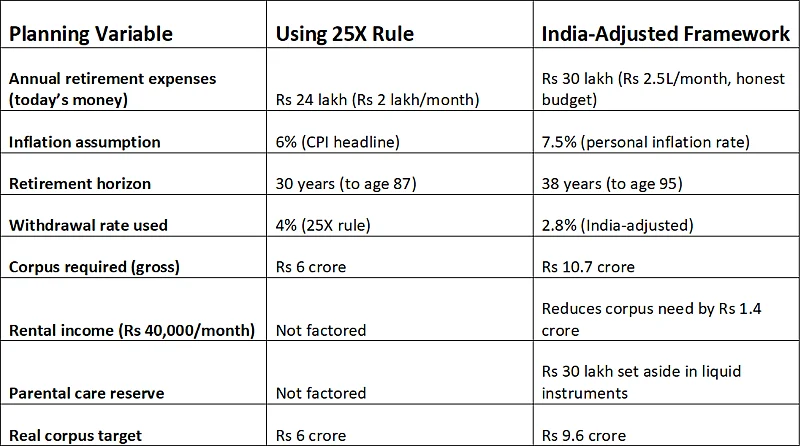
The 25X calculation told Deepa she needed Rs 6 crore. But India-adjusted framework, that is built around her actual inflation, her realistic longevity, her honest retirement budget, and parental care that nobody else had thought to include arrives at Rs 9.6 crore. That is a Rs 3.6 crore gap. At her current savings rate, it translates to retiring at 61 or 62 rather than 57.
That is not a catastrophic finding. It is a correctable one, but only if discovered at 48, not at 56.

The Questions To Ask Your Advisor
The next time someone gives you a retirement corpus target—whether it’s a number, a multiple, or a rule—ask them these:
What inflation rate did you use, and is it my personal inflation rate or headline CPI?
What age did you plan up to, and why?
Did you account for all my income possibilities in retirement?
What happens to this plan if I live 10 years longer than your projection?
Have you factored in what I may need to spend on my parents’ care, and for how long?
If your advisor cannot answer all five with specific numbers, not just reassurance—you do not yet have a retirement plan.
Back To Deepa
Deepa is not behind or in trouble. She is a few years away from where she thought she was, which, at 48, is entirely recoverable. She has time to close the gap, restructure her savings rate, and build the retirement income layers that reduce the corpus burden.
The 25X rule gave her a target that felt achievable. The five-factor framework gives her a target that is accurate. There is a difference between the two. And it is worth knowing which one you are working with.
Know someone who has been using 25X as their retirement north star? Worth sending this before they discover the gap themselves.
The author is a Certified Financial Planner and Co-Founder of House of Alpha Investment Advisers. This article is for informational purposes only and does not constitute investment advice. All figures used are illustrative. Please consult a qualified financial advisor for personalised guidance.
(Disclaimer: Views expressed are the author’s own, and Outlook Money does not necessarily subscribe to them. Outlook Money shall not be responsible for any damage caused to any person/organisation directly or indirectly.)





